
Villa Griffone
How I followed Marconi's steps on the foothills of a global communications revolution
In the depths of the British winter, my wife Jo took off to visit her family and friends in New Zealand and Australia. I looked after myself for a month, then drove our little 1.2 litre Honda Jazz over the Alps to meet her in Rome and begin a five-week tour of Italy and France together.
I had packed my Xiegu G90 radio, JPC-12 antenna and Morse key of course, so I had the fun of working around the world from an olive grove in Campania, the Mediterranean shoreline in Liguria and the vineyards of Provence.
Some highlights of our trip were always part of the plan: The ancient remains of Pompeii, Herculaneum and Paestum were awe-inspiring. At sunset, the beautifully engineered Roman aqueduct at Pont-du-Gard was as lovely as the medieval glories of Bologna. It all contrasted with the gorgeous creations at the Lamborghini factory.
But travel must always allow for the unexpected, and surprises often provide the most memorable moments. So imagine my glee when staying in a converted pigsty in northern Italy to discover that we were less than 20km from the family home of radio pioneer Guglielmo Marconi. Not only that, the Villa Griffone was the location of his groundbreaking early experiments and offered tours by prior arrangement.
I wrote a polite email to the administrator, enquiring if I might be able to visit on a Sunday morning. A day later, I was thrilled to find that Jo and I were allowed to join a very large group of Italian amateur radio operators from Tuscany and their families.
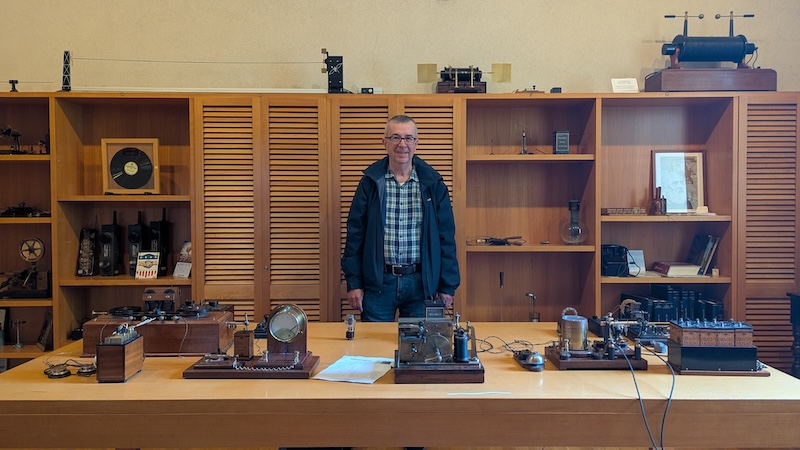
We were shown into a theatre and introduced to the museum and Marconi's life and work in a 20-minute lecture. Then we joined a group for a tour, which began with a scientific demonstration. Our young guide was not a licensed amateur but he was exceptionally good. He stood behind a large table, on which was arrayed replica equipment on wooden plinths - all polished brass, wires with woven fabric insulation. He reached behind him to a high shelf and keyed a straight key. A fat spark sizzled across a 50mm gap on top of a large induction coil. He then connected a receiver on the table in front of us and showed us a coherer, the RF detector that Marconi famously improved with a self-resetting device. Now when he keyed the spark transmitter, a brass bell connected to the receiver rang out "SOS". He swapped out the bell for an inker, which prints out the dots and dashes of Morse on a thin paper tape. I listened to the buzzing spark and shouted out "CIAO", to the consternation of several of the visitors.
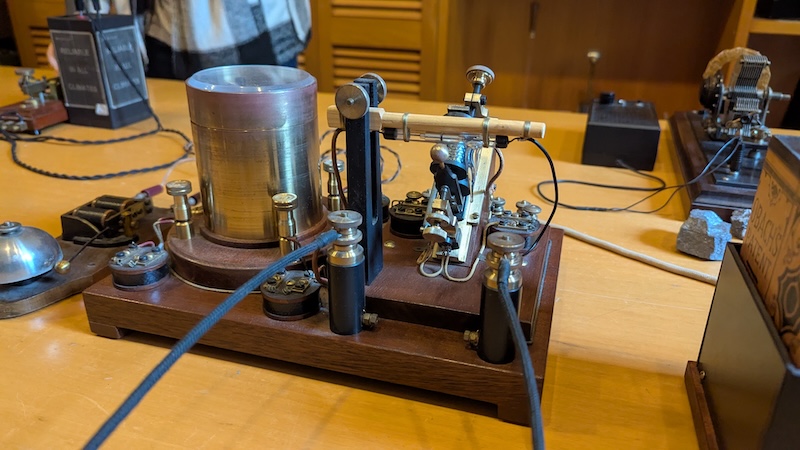
I had done some reading about the coherer. Marconi had followed the work of Branly and Varley in exploiting the phenomenon by which loosely gathered small particles of copper or other conducting substances would clump together in the presence of electromagnetic radiation. As they did so, their electrical resistance dropped. Marconi could make the copper shavings inside a vacuum tube twitch when he keyed his transmitter. But to make use of on-off signalling, once the shavings had cohered, they somehow needed to be reset. His simple solution was to put an automatic tapping hammer against the coherer tube, driven with a make-and-break circuit. The changing resistance of Marconi's decoherer enabled a pulsing current to flow in the receiving equipment which corresponded with the transmissions. I was amazed to see it all working on the table before us and the original devices in glass display cases.
Marconi now had a reliable means of receiving transmitted messages over the distance of a few feet. He sensed that far more was possible and dreamed of making transmissions beyond the horizon.
In the silkworm at the top of the villa, where caterpillars were once fed on mulberry leaves, Marconi's research laboratory had been recreated. I recognised Leyden jars, gold-leaf electroscopes and the flat metal sheets that he used as primitive antennas.
An interactive area was set up so that visitors of all ages could play. I waited my turn and enjoyed using a spark transmitter to send Morse Code (not continuous wave) to a receiver a few feet away.
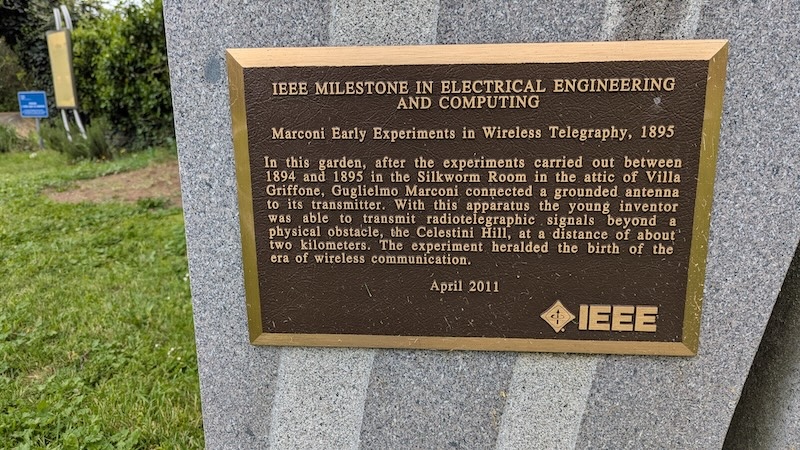
There was so much to see. I was also eager to emulate Marconi's consequential experiment of 1895, which is commemorated with a plaque in the garden. To a companion two kilometres away on the other side of the Celestine Hill, Marconi sent a message to demonstrate the first non-line-of-sight radio communication. I asked for permission to emulate the feat, which was freely granted. I set up my radio under the silk room window. I switched on the radio and to my surprise and joy, I heard a spark transmission. Someone in the museum was sending "SOS" and I could see it across the waterfall on my G90. Since 1924, spark gap transmitters were banned from the amateur bands and in 1934 they were outlawed for all radio transmissions. There can't be many people alive today who have heard, on their own radio receiver, a Morse Code message sent as a spark gap transmission.
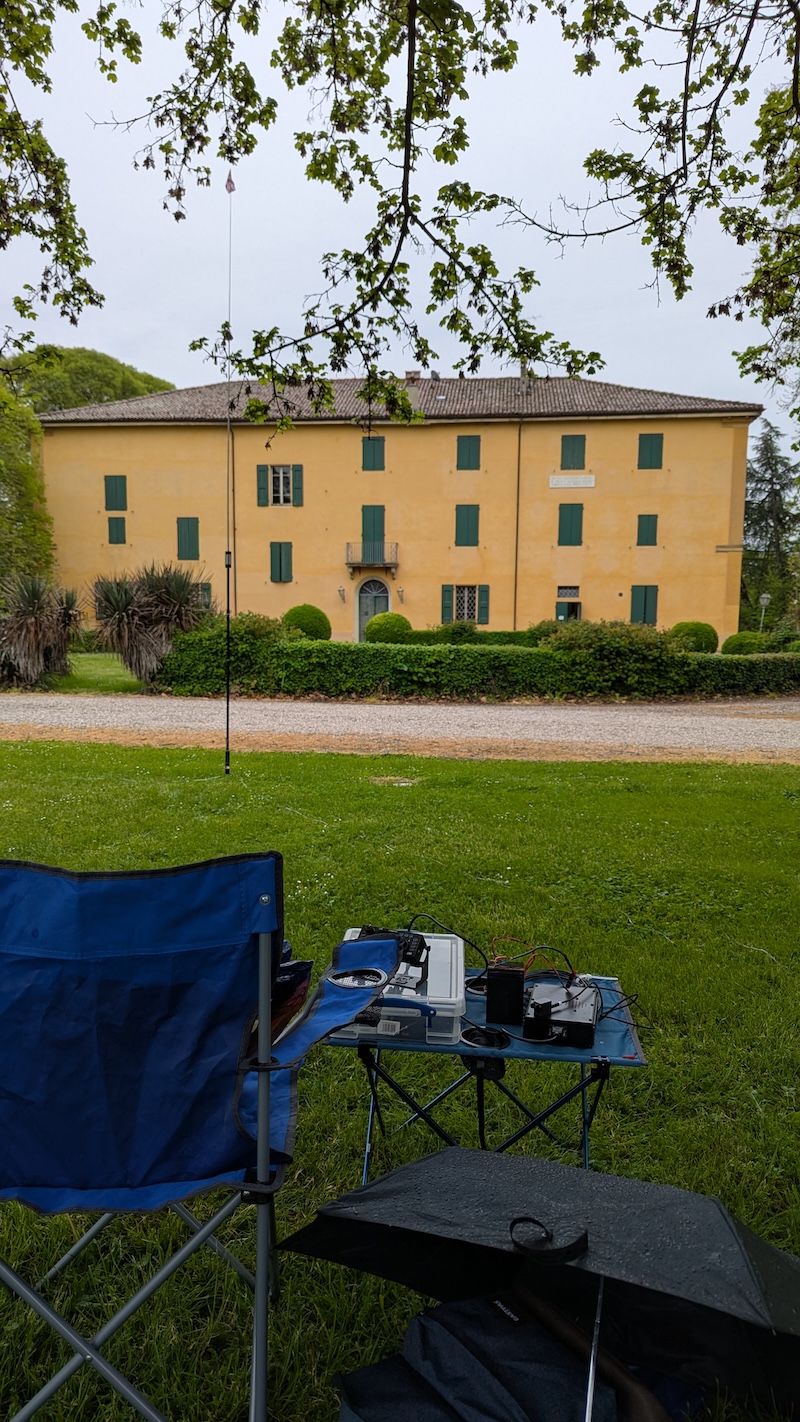
I was desperate to get a call out. I called “CQ DE I4/M0KBJ” and had pleasant exchanges with Brian G4BIP in Northamptonshire and Derek G4VWI in Leicester. They were not much more than 1000km away and I thought about how the limits of transmission grew so spectacularly in just a short time at the end of the nineteenth century.
The real spirit of radio is experimentation and making discoveries for ourselves. Anyone whose heart has skipped at the sound of a distant station calling them will know what Marconi experienced 130 years ago at Villa Griffone.