Wednesday 31 December 2025 - End of the year review
On 40m and with 5W, I worked David G4XUV, whose signal was just too feint for me to copy properly. We managed to exchange signal reports and names but that was about all. I chatted with Tony F8ATS near Paris and with Bryan G0GSY again.
A year ago, I reviewed my radio activities in 2024 and it was really good to see how much I had done.
This year has been equally good. The highlight was my trip to France and Italy, especially visiting the wonderful Marconi Museum at Villa Griffone and making low power contacts with Australians.
I didn't change much about my equipment, still using the versatile Xiegu G90 with the half-size G5RV antenna at home and the JPC-12 when out and about. I did add two new Putikeeg keys at the start and end of the year. The diminutive, and slightly disappointing, Mini and the excellent MCT20 Classic.
My statistics for contacts made with my own callsign during the year are:
- QSOs: 356
- CW QSOs: 348 (98%)
- SSB QSOs: 7
- Other modes: 0
- Countries/DXCC: 41
- New countries/DXCC: San Marino, China(?), USA, Macedonia, Salamis Island, Estonia, Isle of Man
- Unique stations worked: 286
- Bands used: 40m, 30m, 20m, 17m, 15m, 10m
- Most frequently contacted: Bryan G0GSY, Paul G0OER, NRC GB3RS and David VK3DBD.
I'm thankful for every contact and the encouragement that so many people have brought me.
In last year's review I looked forward and, as well as anticipating the big European trip, I hoped to progress with some home-brewed projects. I haven't done any radio construction but have been working on coding in C++, which has taken more time than I had imagined.
So what do I expect in 2026? I hope to develop my abilities in copying Morse and sending it with a straight key. I'd also like to build a rig control interface for my G90 radio. Let's hope that life in general might brings us more signal than noise.
Tuesday 30 December 2025
Sending clean code with my new straight key isn't as straightforward as I thought it might be. I'm warming up with some practice before attempting a QSO and this certainly helps. I find that I send a high proportion of my code well enough but stumble occasionally. As I improve, those erratic characters reduce but don't disappear completely. It's very irritating to send a nicely composed sentence, only to make an embarrassing hash of the KN at the end of the over. That frustration dents my confidence and makes me more anxious, which leads to more errors. I realise that musicians spend time practising scales and arpeggios and I should probably expect to do the same each day in order to become truly fluent.
True to the spirit of the G-QRP winter sports, I stayed with 5W and called CQ to make five contacts on 40m, all for the first time apart from the first to Durk PA3BYW.
I could only just pick out Werner DL5ANE/P in the noise but we managed well enough. Bob GB4HNY used 10W which sounded incredibly loud, though the format of his special New Year station call threw me. Chris GM4LYN in Fife used just 1W and despite fading we had a nice chat. I ended with Andy M0KZO, whose IC705 pushed 3W from Malvern.
Monday 29 December 2025
Again on 40m and with 5W, I worked Rob G4GIY near York. He's a keen maker and QRP enthusiast and we had a very pleasant 20 minute natter.
Sunday 28 December 2025
The G-QRP Club winter sports season runs from Boxing Day for a week, so I've been keeping the power down to 5W and working mostly inter-G.
Four in the log today, all on 40m. G4BUE and I exchanged signal reports but conditions were against us and he disappeared before I could get a name.
I had slightly better luck with Tim G4ARI and a very nice brief QSO with Ben G4WDZ activating POTA park Waresley Wood near Cambridge for the very first time.
I finished with a local chat with John G4YTJ just down the road in Birmingham.
Friday 26 December 2025
The DARC Christmas Contest filled the 40m band so I moved to 30m for today's activity. I had replaced the cable on the new Putikeeg straight key, fitting a 3.5mm socket to two short leads to the key. This enables me to swap between the straight key and the paddle easily.
I had four fun QSOs. The first with CW novice Pascal F4LQM, whose QRZ.com profile says that he's been active for only a couple of months. His sending was very good and it was a pleasure to help him with experience on the air. Richard G4TPJ and I both struggled with difficult conditions so kept it short. I had more success with Nigel G0UAN and then an excellent ragchew with fellow straight key user Lindy G0GZN in which we compared Christmas presents. I hope to reach her standard of impeccable sending one day.
Thursday 25 December 2025
Before opening Christmas presents, I made a very nice QSO with Jon GW0FJT in Llandeilo, using 5W on 40m.
My lovely wife Jo gifted me a Putikeeg heavy duty classic straight key. It has a terrific action and a real substantial presence on the bench.
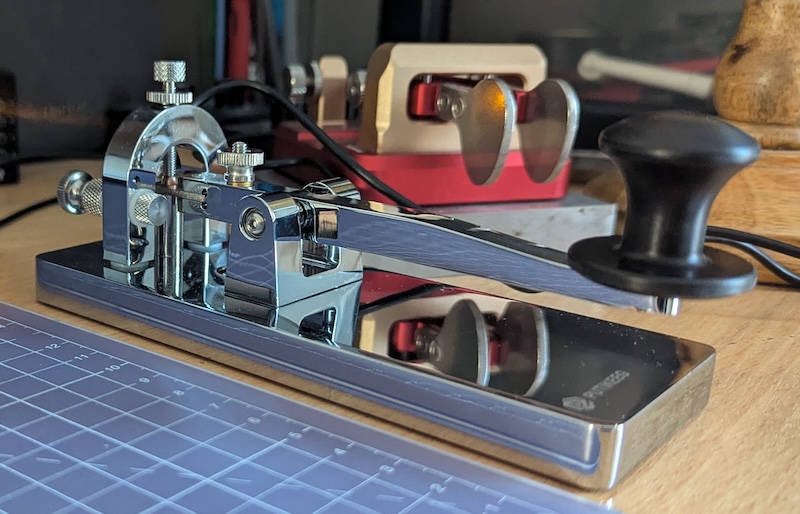
My friend Chris G7BED answered my CQ call and we chatted about the new key.
Later in the afternoon, I QSOd with Lars LA4EJA not far from Oslo, who offered kind words about my sending. I will improve as I get used to the key but even straight out of the box, it's been a great experience.
Tuesday 23 December 2025
Paddy G4MAD answered my CQ call on 40m just as the band was closing. We both found that our signals faded over a period of ten minutes so just about managed to squeeze in the last merry Christmas message.
Sunday 21 December 2025
After returning home from the East Riding of Yorkshire, I picked up a HamAlert from GB3RS on 40m. It turned out to be my friend Chris G7BED on the NRC's Yaesu FTDX5000 just before closing time, so I seized the opportunity to send season's greetings.
Friday 19 December 2025
Bryan G0GSY is my third-most contacted station at eleven QSOs so far. He's in Cleethorpes near the Humber estuary where I shall be heading tomorrow to see friends. We chatted (on the key) for about fifteen minutes. At this time of year, ragchews always end with, "MERRY XMAS ES HNY" or similar.
Tuesday 16 December 2025
It's been a couple of weeks since I operated and I really noticed how out of practice with sending I was this morning.
Conditions on 40m were excellent and I enjoyed listening to Andy G4KKU chat away with Mark G4BED at over 20wpm and copied most of what they sent. When they finished, I thought I'd try for a QSO. Although Mark answered, he disappeared after the first over. To be fair, I struggled to send the "L" in Wolverhampton so many times that he probably thought I was completely inept.
A German station took over the frequency, so I shuffled up 500Hz and called CQ. Andy answered and we had a lovely chat for over half-an-hour. It turns out that we met in Shirehampton last year when his club made me very welcome at their weekly meeting. Andy knows Wolverhampton too, having worked here for a while. I apologised for my shaky sending but his patience gave me confidence and I became more fluent as we ragchewed. I shall have to put in more practice!
Sunset approaches quickly these days so in the late afternoon I jumped on the 40m band again to work Tony M0PKD in Accrington and Steve G4HXY in Essex, both for the first time.
Thursday 4 December 2025 - QRPP and QRPPP
Interesting things happen to the bands at sunrise and sunset. I worked Steve M0STN in Northampton with 5W both ways. He gave me RST 599 and I gave 589. We both dropped the power to 3W and there was barely any difference in signal. Could we go lower?
Sure enough, down at 1W we had perfect copy, despite my noise levels on 40m being around S6.
Steve's IC705 can drop further, so he wound the power down to 500mW and I gave him a report of 579. Then incredibly, I just about copied him when he sent 100mW.
When Steve wound the power back up to 5W it sounded very strong indeed!
The delightful thing about propagation is the surprises that it brings. A contact over 56 miles distance with miniscule power can be just as much fun as an exotic DX station running kilowatts.
To round off a very pleasant session I had a 1W - 1W QSO with my NRC friend David G3DJB.
Wednesday 3 December 2025
I found Brian ZL3XDJ calling on 20m and his signal was the best I have heard from him all season. 0800 to 0900 seems to be the best time to work NZ on the long path at this time of year. Sadly though, my 20W just wasn't enough for a QSO.
Not too disappointed though, I had nice first-time contacts with Vlad U25DM in Ukraine, a special event station EG1NV marking Christmas in the Spanish city of Vigo and Klaus DH7NK near Frankfurt.
Tuesday 2 December 2025
I had no success looking for DX on the greyline this morning, either on 20m or 30m.
Later in the day however, I picked up three UK contacts with QRP power on 40m: Roy G4DMC, Mike G3YPE (also QRP) and Alan G3ZIK.
Roy had to cut short our contact as his son arrived. Mike and I chatted for several minutes. Alan told me that he had been licenced in 1970 before signing off in order to make his mug of tea. All jolly good fun!
In the mix was Paddy G4MAD, who attempted to answer my CQ call but was thwarted by the propagation which didn't allow us to make a contact. I could just about hear a signal down in the noise but it was nowhere near workable.
Friday 28 November 2025
I managed a one-minute QSO with Mikko OH3FM in Finland on 40m as the sun rose but we were cut short by the rapidly fading propagation.
Thursday 27 November 2025
My log - and this blog - record contacts I have made but not the ones I didn't. I thought that it would be good to mention that over the last week I have been hunting for a contact with Brian ZL3XDJ who operates with a beautifully simple station from the South Island of New Zealand on the 20m band.
This morning his signals were about RST 219, not sufficient again for me to attempt a reply.
Will I ever repeat the magnificent contact from last year?
I turned away from the quest for DX to the 40m band and worked Ivan M0NMM, a professional pilot in Cambridge, for the first time.
After that fascinating contact, I called CQ with 5W on the QRP centre of activity, 7030kHz. Within a minute, I was answered by Dave G0DJA in Bolsover who was also using 5W. There was some fading on the band but we persevered and had a perfectly good QSO.
So an hour after hoping for a trans-world contact I was delighted to chat across just 50 miles away on very low power.
One last call before my radio day ended: A decent ragchew with Keith G4TJE in Sevenoaks.
Tuesday 25 November 2025
Band conditions not looking too good at breakfast time. I managed a brief exchange with special event station DL2025B on 20m and couldn't find anyone else.
I had a delightful ragchew with Edd G3WNQ in Mablethorpe on 40m. He told me that he started learning CW in his teens and went on to serve in the merchant navy before a long career as radio officer at Humber Radio GND, providing a vital ship-to-shore service. Now in his eighties Edd must have sent countless messages professionally and as an amateur.
Just after sunset the 40m band opened for some distant stations. With 20W I worked Peter in Hradec Králové, Czechia, who was operating special event station OK1KHK to celebrate the 800th anniversary of the city's foundation on the River Elbe.
Up on 20m, I worked another Czech station, Emil OK2BPU. Sadly, although his signal began at a very distinct 579, it faded to nothing on our second over and I heard nothing more. The maximum usable frequency (MUF) for our 900 mile link path must have rapidly fallen below 14MHz.
Monday 24 November 2025
After breakfast I jumped on 40m and called CQ with 5W on the FISTS frequency of 7028kHz. Two nice chats, one with Gil ON6QS and one with my friend from the NRC, Chris G7BED, with whom I celebrated the pleasure of Monday morning radio in retirement.
After lunch, I kept the power to 5W and on 40m worked Luc ON7DQ in Holland, a keen constructor who was using a QCX radio. It was a faint signal with some QSB but I copied everything.
I followed on with Durk PA3BYW who was using another radio from the QRP Labs stable, the QMX.
Rich G4PCE and I made contact for the first time. He's only a short distance down the M6 in Solihull. We chatted for quite a while and I see from his QRZ.com page that he has an excellent collection of radios.
Sunday 23 November 2025
If yesterday provided some good DX conditions, today was all about the homely 40m band for me. With strong propagation, I dropped my power to 5W and worked three stations.
Les G0DFC was a first-time QSO for me and we had a relaxed chat. Then I worked Tom F4GOU whose bug provided a nice swing. Last up was Matthew M0MZB who was brisk but made for great copy with his accuracy.
Saturday 22 November 2025 - interesting DX
I warmed up on 20m with a brief QSO with Tina (personal callsign DL5YL) who was operating as DM88YLF, a special event station to encourage activity between women operators ("YLs") in France and Germany.
I heard my first Japanese station, JE1RXJ, calling CQ on 14027 but he couldn't hear my replies. From his QRZ page, it looks like he was pushing out 1kW.
I stumbled into David VK3DBD in a QSO with James VK3JFR - the first time that I have heard two Australians talking together. When they finished, I managed to work David but it wasn't easy copy.
Dropping down to 40m, I worked James G0EUN for the first time. He told me that he's 94 years old. His code was flawless!
Still on 40m, my friend David answered my CQ call with his new callsign, G3DJB, for a brief chat before he went out shopping.
I finished with an easy going chat with Iain GM4HBG in Forth.
Friday 21 November 2025
I met Dave G0FVV for the first time, on 7014KHz. We had a nice ragchew in which he told me that he's 70 years old and was licensed in 1983. He lives in Mansfield and the skip was just about open for us at 0826. I got to send my first minus sign on the air, as our frosty morning is just -2C.
Monday 17 November 2025
At 0700, I searched around the 20m and 30m bands for some DX but couldn't find a contact. Back on 40m, I QSO'd with Fred G4HOM in north Birmingham, just 9 miles away. The propagation was difficult, but improved during our chat once the critical frequency rose to 7MHz. Fred was using his Elecraft K3, a radio that I'd love to own.
Later in the day, I chatted with Bob ON4LDL on 40m and Dan SM5IMO on 20m. My contact with Dan in Sweden earned my a 559 report for just 2W power.
Wednesday 12 November 2025
I saw that Paul G0OER was calling CQ on 40m so jumped on for a quick hello.
Sunday 9 November 2025
I hopped on the air during the FISTS ladder activity and worked relative newcomer Gary M9RTG. He's doing exceptionally well, having only been licensed for a year. His profile page shows that he is an former member of the Royal Corps of Signals, so perhaps he had some prior experience with CW.
I then heard familiar callsigns and worked Bryan G0GSY (tenth time) and Mike M6MPC (fifth time).
Friday 7 November 2025
I was pleased to have a first-time contact with Ken G0OBK in Nottingham, whose sending with a straight key was spot on for me to copy easily.
My CQ call was answered by Mike, one of the members of the Marine Radio Museum in Wallasey, operating their station G5MPR. He was using a bug and happily responded to my request to QRS. Of course, the speed of the dits on a mechanical bug can't easily be changed, so Mike allowed more spacing which meant that I could copy him.
I learned from this video that Mariners Park, which is where the station is based, is a residential development for retired seafarers. Most of the club's members are former ships' radio officers.
I made a first contact with Giles G0NXA which was sadly cut short by another station tuning up and calling on top of us. The contact was challenging because I had removed a jumper link inside my LPSCAF audio filter which, although resolving faint signals even better than before, made my own sidetone extremely strong. I jumped when I first used the key and I had to adjust the filter between each over.
I finished for the day with a sixth QSO with Horst DK4AC who was using 750W. His QRO signal was certainly strong but unnecessarily so.
Tuesday 4 November 2025
What a privilege to work the hugely inspiring Rolf DL3AO this morning. He was calling CQ on 7031kHz and I was delighted when he heard my reply. From his extensive profile on QRZ.com, Rolf was licensed in 1949 and is now in his tenth decade. It's incredible to think that he has been on the air for 76 years. At the age of fifteen, he picked up surplus military equipment but went on to build very impressively. I particularly like the photograph of the sophisticated AM transceiver that he built in 1956 which is, he says, still awaiting some finishing touches!
There is so much to admire in Rolf's story. Apart from his sheer longevity, he has combined technical skills in construction with enthusiasm for real communication between radio operators.
Later in the day, I worked Mark M0ZMX and Ben G4WDZ. Mark's Elecraft K3 had a real toot-toot sound, which I enjoyed.
Monday 3 November 2025
Propagation looked poor today and the bands were fairly quiet so it was a nice surprise to exchange 599 reports with Steve M0STN. He was using a Yaesu FTDX101MP with 125W from Northampton.
Wednesday 29 October 2025 - a new DXCC
I warmed up with a brief chat with Bert PA3EPA near the Hook of Holland and then heard an unfamiliar callsign GD4EIP in a QSO. When he finished, I called him and was really pleased to chat with Colyn for several minutes. He lives in Foxdale and is one of a small number of active CW operators on the Isle of Man, which became the 55th country/entity in my logbook. Colyn told me that he was licensed in 1962, the year before I was born. His QRZ page profile says that he's operated in CW mode ever since.
Tuesday 28 October 2025
Two lovely 40m QSOs this morning despite a noisy band. First with Hans DK1WU near Cologne and then with Terry G4AYR, a retired scientist who worked at the Natural History Museum, of which I have many fond memories. He still enjoys study and research as well as exploring radio technology.
Saturday 25 October 2025
I reconnected my G90 and found that conditions on the 40m band are excellent today. I worked Allan G4NNJ, Peter M0CYR and my first M9 callsign, Phil M9PHL in Ely.
It turned out to be Phil's first QSO as M9PHL. He's just changed his callsign from 2E0DPH under the latest Ofcom regulations. It's a privilege to be the first in his new log.
Later, I worked Ian G4HJM in a proper ragchew in which we discussed our howlers with soldering irons and the risks of eating wild mushrooms.
I called CQ on 40m which is still working well and heard Jack G0DOZ's faint reply. I was thrilled to hear that his homebrew rig was pushing out just 1W and I'm eager to know more about it.
Friday 24 October 2025
I kept the QCX+ connected to the antenna and worked one station, Tom F4GOU. Tom only gave me a 329 report and it made me wonder just how much power my radio was putting out. It's a nominal 5W and that's the figure that I have been giving in my QSOs. But is it really 5W? I suspected that it is much less. I knew that Hans Summers, the man behind QRP Labs, had put together some information about maximising the output so I thought I'd better investigate.
Hans' video, Tuning up your QCX+, pays a lot of attention to the inductors in the low pass filter between the power amplifier and the antenna. I carefully followed his instructions and removed 3 turns from one of the inductors. I measure the output voltage across my 50 Ohm dummy load and found that I could improve the output from 160mW to 400mW.
Whilst it was annoying that I couldn't make any further improvement, I was really pleased with how well I have been doing with less than a fifth of a watt. Yesterday I contacted Jack in Finland, who is 1200 miles away. This equates to an astonishing 7500 miles per watt!
Thursday 23 October 2025 - QCX+ comes out to play
It was great fun to use my QCX+, which I built as a kit a couple of years ago. I had thought that a good way to start in the hobby was to buy an affordable low power transceiver. I know now that operating with 5W isn't easy and there's a bit of a knack to getting contacts. I'm glad that I bought the Xiegu G90, which allowed me to make progress and gain experience. That meant putting away the QCX+ for a long time.
I was in the mood to try it out again today and had QSOs with Jack OH3GZ in Finland, Klaus DK5LN in Germany, Florian DL1FOB and Niels OZ1CGQ in northern Denmark.
I thoroughly enjoyed myself and wonder if I should get another QCX for 40m, or even a multiband QMX.
Wednesday 22 October 2025
Great conditions for inter-G on 40m this morning. I worked Mark M0ZMX in Rochester for the third time. We exchanged equal 599 reports but our working conditions were very unequal! I ran 5W to my G5RV Junior antenna at only 7m. He pushed 200W from his beautiful IC-7800 to a lovely Steppir Yagi. I guess that his radio and antenna cost well over fifty times more than mine.
Mark had to go so kindly left the frequency to me. My friend Paul G0OER stepped up and we had a brief QSO with the benefit of his Ten Tec Corsair II.
Tuesday 21 October 2025 - fuzzy brain
I've had some disrupted sleep over the last couple of days and it's left my brain feeling like it's running in a low power mode! So it was with some difficulty that I head-copied stations who were sending just above 20wpm.
I managed to work Didy DM2BRF, then special event station ON4TOR/P at Château de la Royère in Belgium, ending up with Ian G4MLW in York.
Monday 20 October 2025 - the best radio website?
I was unable to sleep beyond 5am, so got up early. After catching up with news over breakfast, I took myself to the radio. Conditions this morning don't favour short-range contacts and I could only hear a handful of stations on the 40m band. But what looked unpromising led me to an amazing find...
I first worked Angelo HB9FBT in southern Switzerland near the German border.
Tuning a little farther up the dial I found Karl DJ5IL calling CQ with a brisk but perfect cadence. Was he going too fast for me? I decided to give him a try.
Top operators like Karl are much easier to copy, thanks to a subtle but most important element in Morse code. Popular opinion would suggest that the simplicity of the code lies in its fundamental dots and dashes. After all, there is nothing else to hear.
But that's wrong! Apart from dots and dashes, which we radio operators refer to as dits and dahs, there are even more fundamental elements - the precious gaps. Within each character, tiny inter-elemental gaps of around 20 to 40 milliseconds allow us to hear. And between characters, gaps which are just over twice that allow us to hear the difference between "AN" and "P". Then after each word, a good operator - and Karl is certainly that - gives his or her partner in conversation a pause which allows the brain to do its work of assembling sequential letters into words and meaning.
It was a pleasure to work Karl, who was using a transceiver of my dreams, the fabulous Elecraft K4D. As we briefly chatted, I looked up his callsign and found his beautiful website. It's crafted immaculately and is full of fascinating technical detail, which I shall explore in depth. For now though, I'll simply post a paragraph that Karl uses near the top of his page to introduce Ham Spirit:
Every minute of every hour of every day radio amateurs all over the world communicate with each other and discover new friends while experimenting with different and exciting new ways to advance the science and art of radio. We are a global fraternity of dedicated people who share a common passion, able to exchange ideas and to learn more about each other by overriding the boundaries of nationality, ideology and religion.
Friday 17 October 2025 - Leaving the radio on
I've been quite intentional about my radio operating. When the mood takes me, I typically switch on and check out activity on the 40m and 20m bands. A quick glance at the tiny waterfall on my G90 gives me some idea but for a better sense of what's going on I open the CW Club RBN Spotter page on my laptop. This shows which stations have been picked up by which skimmers in the last few minutes. It gives me an idea about propagation conditions and also whether many pepole are on the air. If I see a station that appeals, I'll tune to their frequency and see if I can work them. If I'm unsuccessful, I'll often find a frequency and call CQ.
Today I thought I'd try a different approach, simply leaving the radio on at a frequency of 7028kHz, which is the FISTS centre of activity on the 40m band, while I got on with other things.
It was nice to hang around and see who turned up, like waiting on a street corner to see who might drift along.
The background noise wasn't too much of a distraction but I don't think I'd like to have it on while focussing on coding or some othe task requiring lots of concentration.
With this laid back approach, I worked Paul G4LNA, Frank PA3U, Mike G5MPR, and Ray G3XLG.
Tuesday 14 October 2025
It was a real pleasure to chat with Patrick VK2IOW for the tenth time. I could only just copy him with my radio so I switched to the Woofferton Kiwi-SDR for a really clear signal.
Monday 13 October 2025
I had a lovely long chat with Gerald G3MCK in Rutland, followed by a shorter exchange with Peter HA5OV, all the way in Budapest. It's unusual for me to make a 40m contact over a thousand miles.
Sunday 12 October 2025
Just a quick one: II5GG paying tribute to Galileo Galilei.
Friday 10 October 2025
The Swiss Air Force Museum amateur radio club is commemorating international space week with a special callsign HB9SPACE and we made a brief exchange on 40m.
Thursday 09 October 2025
Ian G4JQT/P and I made a QRP/QRP contact using 5W both ways.
I don't often work at the lower end of the 40m CW allocation but I heard Michel ON4KMC in a QSO at a steady speed with a distinctive chirp. I followed on and we had a nice chat. He used a 4W homebrewed transceiver and I kept my power down to 5W.
Staying on 7004kHz, I worked Max F6BII in the town of Néris-les-Bains. I quickly looked it up on Wikipedia and we chatted about the hot water springs that the town is famous for.
It was a pleasure to QSO with Luke 2E0RPQ who has only been operating CW for one year. His code is excellent, sent at a good speed and very accurate. Luke writes a blog about his radio hobby called Trails and Transmissions, which I look forward to reading.
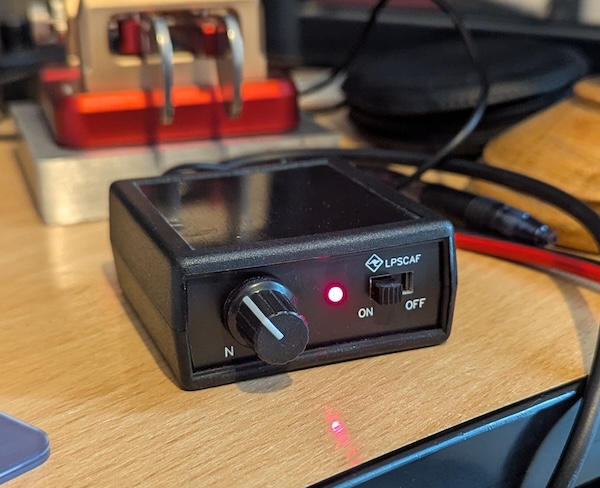
For QSOs yesterday and today, I have been using a low pass state capacitance active filter, which I built as a kit from Kanga Products. It connects between the audio output of the radio and my headphones and beautifully filters the audio to reduce the noise very significantly, greatly improving the quality of the sound and making the noise on 40m much less harsh.
Wednesday 8 October 2025
Up on 17m, I worked Fred DL5YM in eastern Germany using just 2W.
Halving my power to 1W, I chatted with Peter G3WHO who used to work in Wolverhampton as a hospital doctor. His code was absolutely steady and perfectly formed, which made for easy copy.
With the band conditions being so good, I thought I would try SSB with QRP power. Raising my output to 5W, I made a brief voice QSO with Adrian M7EFA in West Sussex.
Tuesday 7 October 2025
I've been busy coding in recent days and making great progress with my project. I'll share more soon.
I got a great 559 report for my 5W from Brane YT3D, whose beam antenna in Serbia is up at 30m!
I kept the power down for some nice UK contacts with Robin G4GIY/P doing a SOTA activation, Mike M6MPC in Tintwistle, John G3RXA, Lin G4DZE, who drives steam trains for fun. I started the QSO with Lin using 1W but had to push it up to 10W at the end because of some intermittent QRM at his end.
Friday 3 October2025
Nice chat with Gé PA3ACF, a jazz musician in the Netherlands.
Monday 29 September 2025
Super chat on 20m with Andres EA2AJB in Spain.
Sunday 28 September 2025
Really easy copy from Alfredo EA1FCL on 20m, less so from Frank OV1CDX on 40m. Also on 40m got Steve M0SHM.
Friday 26 September 2025
It's a long time since I had a QSO with Simon G0FOZ. I passed greetings to his cat Bug. I also worked Paul G0OER and M0LBL, all on 40m.
Up on 15m, I logged special event stations II0IARU and ES90ERAU (my first QSO with Estonia).
Thursday 25 September 2025
A brief SOTA QSO with Paul GW0OER/P, who was on the summit of Sugar Loaf Hill, near Abergavenny.
Sunday 21 September 2025
I ran out of things to say to Paul G0OER!
Saturday 20 September 2025 - Morse timings
As part of a project that I'm working on, I wanted to find out what timings my basic straight key sending was at a gentle pace.
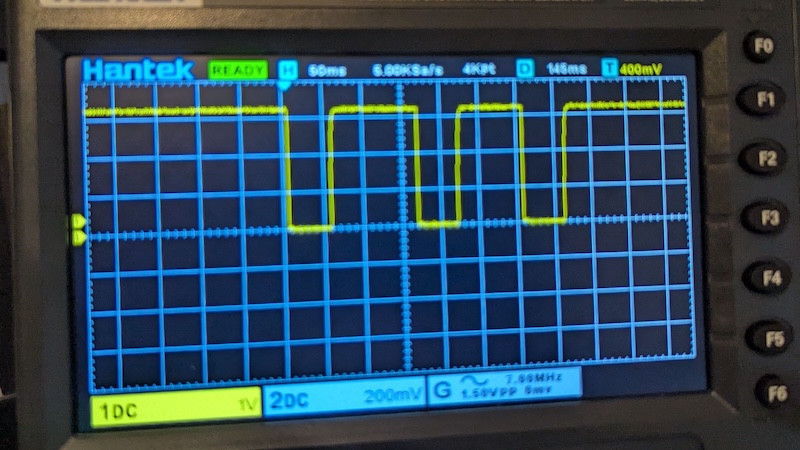
The oscilloscope trace shows a low on key down. I seem to be fairly consistent with dits of 60ms, dahs of 200ms and gaps between elements of around 90ms. That's typical of manual operation, whereas the standard settings used by computers and keyers would be 60, 180 and 60ms respectively.
Friday 19 September 2025
I worked a couple of bands throughout the day, noticing how noisy 40m is compared with 17m at my home.
I worked G4XTF on 40m. Switching to 17m, I had a very brief exchange with SA20LM whose nice signal and good sending was spoiled by a splodge of local QRM, and a very brief SOTA contact with LA/DH0JAE in Norway.
Back on 40m, I had a nice first time chat with Enzo M0KTZ who I met at last month's G-QRP rally in Telford. He was using just 3W and I dropped my power to match.
Still on 3W and back up to 17m for LY789A and a good chat with Enrico IX1WNO in Genoa.
Wednesday 17 September 2025 - Museum of Communication
I didn't take my radio on a short trip to Fife this week but I did manage a couple of unexpected QSOs.
Run entirely by volunteers, the Museum of Communication provides the public with a fascinating range of exhibits on the development of radio and television. In September, I spent three happy hours in the company of its chairman Ken GM3YBQ and Rob GM0DUX, who kindly invited me to use their station MM0MOC to work fellow NRC volunteer Derek G4VWI using CW. Sadly, I wasn't able to hear other NRC ops on SSB because of a noisy band.
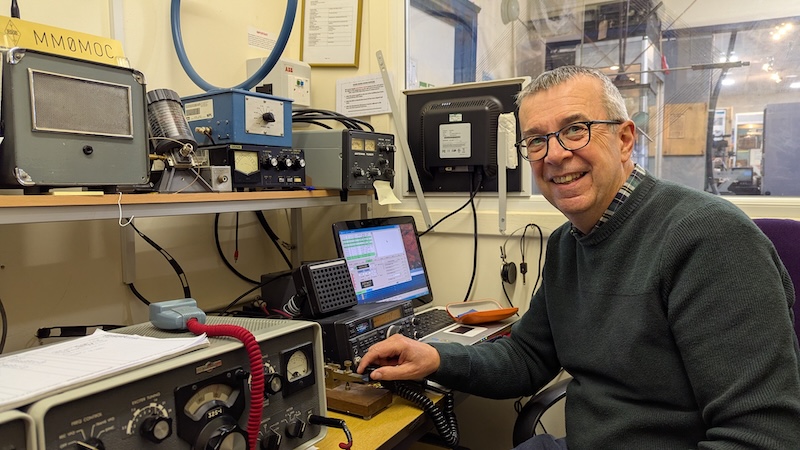
Giving very freely of his time, Ken took pleasure to show me the museum's vast collection, not on public display. It has radio and television equipment from every decade up to the 1970s, including rare sets and test equipment. There are a number of military radios plus the nose radars from the Lightning and TSR2, showing all their wire-wrapped glory.
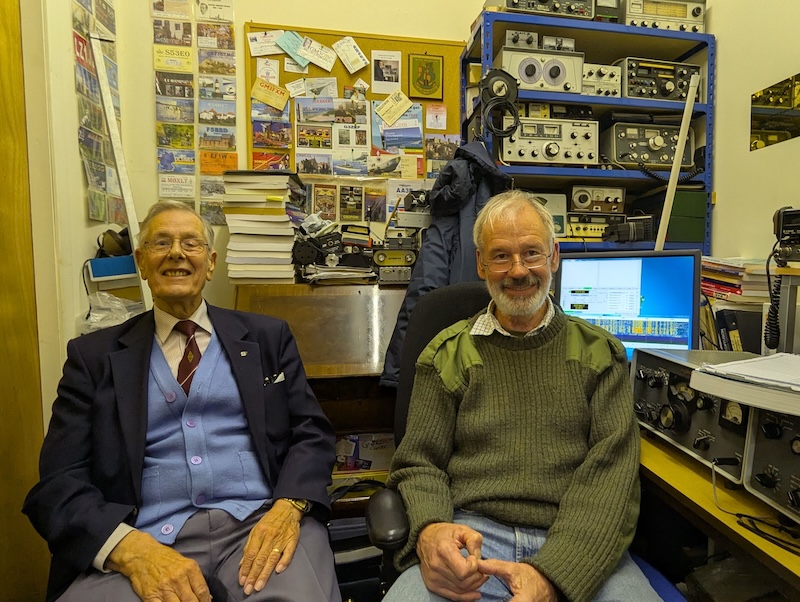
The museum is open Wednesdays and Saturdays in the summer. Check out the website at https://museumofcommunication.org.uk
I would highly recommend it to any amateurs who might be visiting the area.
Monday 15 September 2025
Poor conditions on the 40m band again so I didn't hang around, just getting Ghis F6CEL in the log.
Sunday 14 September 2025 - the simplest key
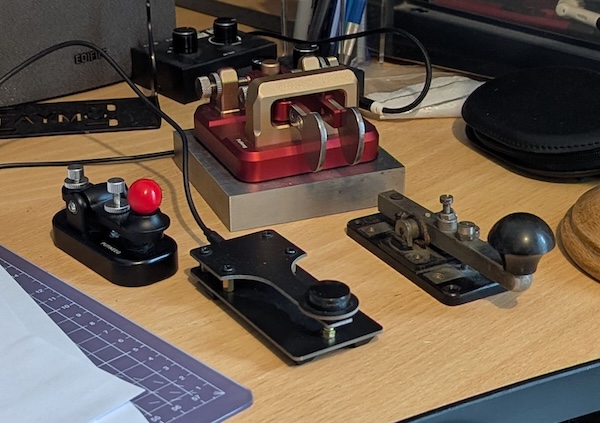
I enjoy using a straight key more than a paddle and I am looking forward to a special Christmas present which should be great fun. Meanwhile, this morning I thought I would dig out the first key that I bought. At that time I wasn't sure that CW would be for me and I didn't want to spend a lot of money. I splashed out a whole £7 on a Kanga Products flat pack key. It's a delightfully simple device, consisting of two printed circuit boards and comes as a kit that can be assembled in a few minutes. The torsion that keeps the contacts apart is provided by the upper circuit board which is bent downwards as the key is depressed.
I used it only for a few weeks after I bought it and moved on to my WT-8A army key but this morning I thought I'd get it out and try it again. It was fun to use something so simple and cheap and it was perfectly good for a slow chat with old friend Keith EI5KJ whose signal came and went in heavy QSB on 40m.
Monday 9 September 2025
It's good to see how other bands are working so todaay I dropped onto the 30m band and worked Erik LA5XTA in Jakobsli, northern Norway, using 5W.
Sunday 8 September 2025 - Quieting the radio
I've been experimenting with running very low RF gain. It's easy to think that it's best to have the greatest sensitivity on the receiver's front end. After all, a weak signal needs to be amplified, right? But of course our goal in receiving is to get the best possible signal-to-noise ratio. Increasing the gain on the first stage of RF amplification will increase the received signal but it will also increase the received noise. My G90 is a software defined radio (SDR), which means that the incoming RF signal is not tightly filtered. Rather, the digitisation of RF signals happens over a wide band and much of the selectivity is achieved in software through mathematical manipulation. If the RF gain is set too high, the receiver has to deal with a high level of signals and noise. By turning the RF gain as low as I can for reasonable sensitivity, I can 'quiet the front end'. Sure enough, in my noisy environment at home, I find that an RF gain setting of 1% to 5% is adequate. Here, the weakest signals are buried in the noise and not receivable. Since all I can work are the signals that appear above the noise background, it's not necessary for the receiver to be highly sensitive. The benefit of reducing the RF gain is a slightly improved signal to noise ratio. Of course, I shall have to remember to increase the RF gain in low-noise environments when I work portable. But for now, a very low setting seems optimal.
I worked Tom DL9DBI in Olpe, Germany on 40m.
Saturday 7 September 2025
With conditions good on 40m, I had a long ragchew with Tom GM0GHN using just 1W to start. The band started to fade so I had to increase power first to 5W and then to 10W. One of the advantages of using very low power is this kind of learning. If I simply ran a 100W rig at full power all the time, I wouldn't be gaining these skills.
Friday 5 September 2025
As band conditions have fluctuated, I've flicked on the radio from time to time to see what's possible. Today, I worked Enrico near Milan IK2FIL in a lovely slow QSO.
Tuesday 2 September 2025 - Australia again!
I got on the air before breakfast to see if I could find any of the Australian stations who meet for the weekly CQ QRS event. After a brief chat with HA3GZ in Hungary, I heard David VK3DBD finishing a QSO and followed on. It's the first time for a long time that I have worked Australia from home and without using a web-SDR to receive.
I found a small but perfectly readable signal from Roel PA2RSD/P who was operating from his Dutch holiday campsite and Paul G4PVM in Essex.
With 40m working really well, I thought I might be able to join the NRC SSB Net. I dug out my dusty microphone and worked Luc ON5SEL/P who was participating in Bunkers on the Air.
Sure enough, I tracked down the NRC Net whch was being controlled by Ed G3ZLX. It was a busy group and we could all hear each other. I even got good reports for my 10W QRP signal.
Monday 1 September 2025 - Great low power DX
Conditions were really favourable this evening, caused by solar activity which promises to bring visible aurora in lower latitudes. I kept the G90 at 5W and worked Vlad EW2AR, who was 1300 miles away near Minsk, Belarus. Things were looking good so I dropped the power to 1W and worked Bryan G0GSY in Grimsby.
I moved up to the 20m band and heard Matthias KC1XX calling from New Hampshire. I have only worked North America from coastal locations up to now so it was terrific to use 10W for a very brief exchange.
Sunday 31 August 2025 - Telford Hamfest and G-QRP Convention
I made the half-hour journey to my first rally and to hear three top-quality talks at the G-QRP Club Convention. At the rally I picked up some useful small switches and sockets.
Daimon G4USI spoke about his prize-winning home-brewed transceiver. Nick M0NTV showed us the Manhattan construction technique and lastly Bill Meara N2CQR and Dean Souleles KK4DAS from the SolderSmoke podcast inspired me with their direct conversion receiver challenge. I'm hugely interested in building this. There's no kit and no bill of parts but there is a schematic and a supportive community on Discord.
When I got home I turned the power of my radio down to 5W. Three QSOs on 40m this morning. First up was Bryan G0GSY, then John GW3VVC in Llanfairpwllgwyngyllgogerychwyrndrobwllllantysiliogogogoch (thankfully he sent "QTH ANGLESEY"), and finally Paul G0OER, who had also been at the convention.
Saturday 30 August 2025 - Spending more time writing code than sending code
I've been on the air under different callsigns recently. First as a volunteer at the RSGB's National Radio Centre as GB3RS. Then last weekend helping to operate the Wolverhampton Amateur Radio Society club station G8TA on the local canal as part of the British Inland Waterways On The Air (BIWOTA) event, where it was a joy to hand my straight key to 18-year-old Harry 2E0XLZ for his first CW QSO. Thanks to Mary G0BQV whose steady and accurate fist made for a wonderful conversation and for the encouraging emails that followed.
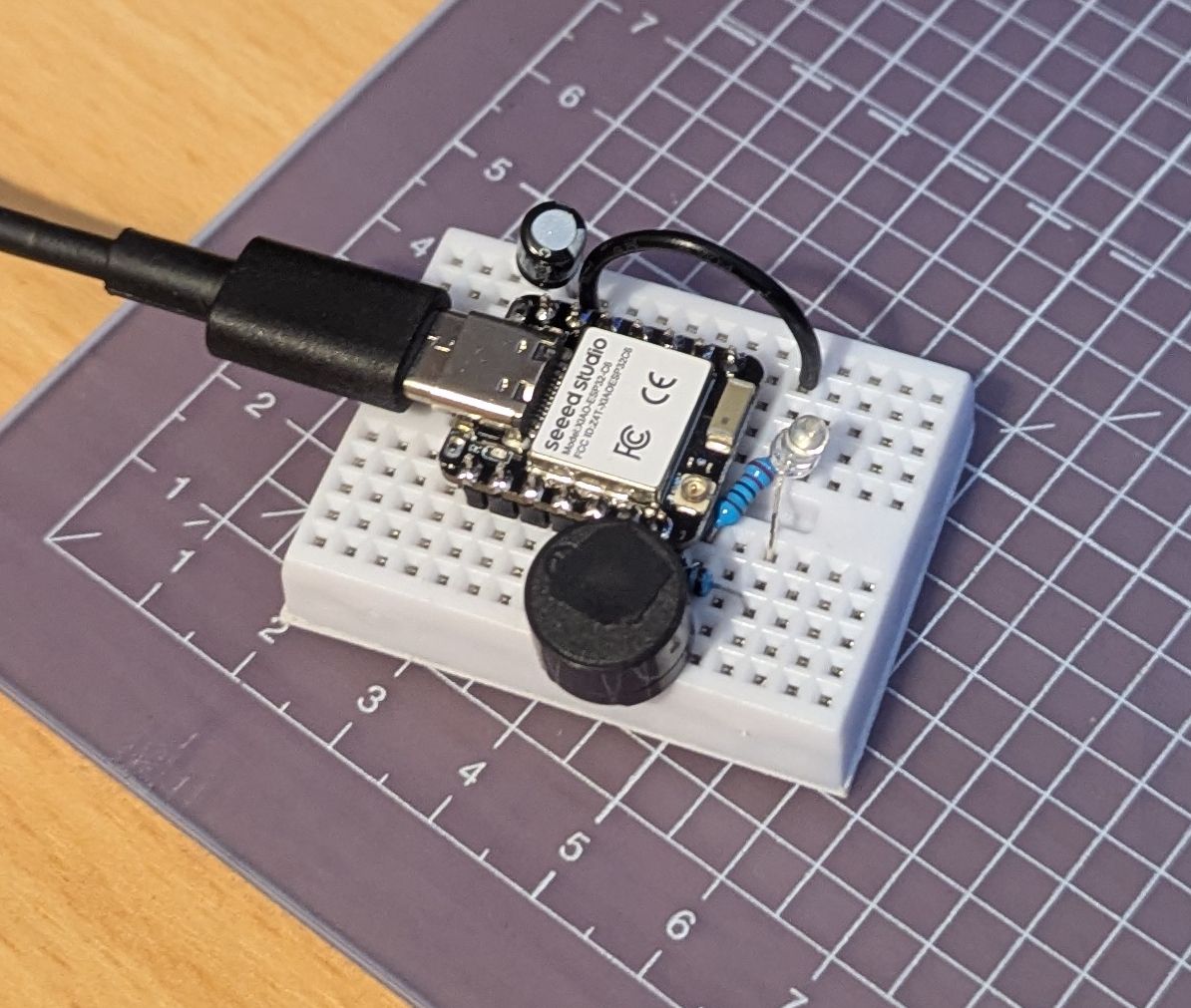
The reason for my two-week absence from the bands as M0KBJ was because I've dedicated my free time to coding. It's been great fun to use the dinky Seeed Studio XIAO ESP32-C6 microcontroller board. It's hard to believe that something so small can be so powerful and so cheap. I have written code to play Morse visually and audibly and will share more when it's ready.
Monday 11 August 2025
Conditions have been poor in recent days and are still not great. I opened a browser window to the web-SDR at Weston-Super-Mare and heard a feint signal from Belgian station Stephen ON5REV/P who was hoping for a WWFF activation. I could only give him a 439 signal report and heavy QSB meant I couldn't catch all of what he was sending. Still, we exchanged callsigns and reports, so I hope our genuine QSO helps him with the activation attempt. I was delighted to see on Stephen's page that he also writes a blog. I shall read about his adventures at cwqrpblog.wordpress.com.
Wednesday 6 August 2025 - Location matters
As I shifted my operating from portable to home in the last week I've once again struggled with the problem of local noise. Away from residential buildings, the noise floor falls away and I can hear even weak signals quite clearly. But back home, I suffer a noise level of around 3 to 5 S-points. That makes it impossible to hear the buried weaker signals. It also means that fatigue sets in after an hour of listening to the stronger ones.
I think I have done everything I can to minimise the noise at home. My experience of working in quiet locations confirms that my Xiegu G90 radio has a sensitivity and sufficient filtering to receive very low signals. That's good news - my reception wouldn't benefit enormously from a new and expensive radio. At home I am using a balanced antenna (a half-size G5RVhalf-size G5RV) which is not particularly susceptible to noise. I have replaced the coax feeder and fitted it with an RF choke near to the radio to eliminate noise picked up on the outside of the coax sheath. Running tests using a battery and confirms that my mains power is not particularly noisy. I have also experimented with a SCAF audio filter, with limited improvement.
So here's the main issue: When it comes to reception, location matters more than anything else.
I will certainly continue to operate from quiet locations when the weather is good. But at home I'm now making the most of the fact that my radio sits on my desk next to my laptop. I have wired an audio switch so I can select between them as sources for the amplified loudspeakers in front of me. Using a web-SDR that has a good signal-to-noise ratio, I can listen through the laptop without lots of noise, then switch back to my radio when transmitting so that I can hear the sidetone from my keying.I have found an inexpensive solution to my local noise issues.
My favourite web-SDRs are those made by KiwiSDR. They're very popular and finding one is made easier with a map and a table of those with the best signal-to-noise ratios. I often use the one at Weston-Super-Mare, which is about 100 miles from my home. I have also found a really quiet one in Sweden, which picks out signals from Australia and New Zealand very well in the early morning on the 20m band.
Is this cheating? It's a fair question to ask. Radio communication is about transmission and reception and by doing half of the work with someone else's equipment in a distant location and using the internet, arguably I'm not following the spirit of HF amateur radio. On the other hand, using different locations for receiving and transmitting is nothing new. It was certainly done by the British during WW2 and, possibly, by amateurs in the 1920s and 1930s.
Remote receiving is the most effective way for me to operate at home, so I'm pretty sure that it's going to be part of my hobby from now on.
Later in the day, I made two QSOs which would have been impossible without using the web-SDR. The first with POTA station Luc ON7DQ/P and the second with my NRC colleague Chris F/G7BED who was using 5W in southern France.
Tuesday 5 August 2025
A couple of short QSOs on 40m today with Paul G6PZ and Joe DF4EW.
Monday 4 August 2025
More on the 40m band. I worked Phillippe F5POJ, John EI6AK and Arnold PA3GDD before a lovely long ragchew with Allan G4NNJ who was using just 4W from his QMX radio in Somerset.
Friday 1 August 2025
I'm enjoying spontaneous radio, flicking a couple of power switches and getting on the air before I've even dressed. So a couple of early chats on 40m this morning, first with Mark M0ZMX in Rochester (our second QSO) and then with relative novice Hans PA4HJB in the Netherlands.
Later in the day, I got a notification from HamAlert to say that my friend Chris was calling CQ as F/G7BED from Provence on the 20m band. I jumped on the radio and was pleased to get a QSO. It's just two months since I was in Provence and struggling to make contact with Chris in the UK.
I closed the evening with a sixth QSO with David M0WDD in Manchester. I enjoy chatting with David, who slows just enough for me to catch every word. He sends CW with precision.
Thursday 31 July 2025
In recent months, almost all of my operating has been outdoors. It's been great fun to enjoy the warm weather and to see who I can work with my JPC-12 antenna and G90 radio. But summer is a good time to think ahead and plan for the chilly seasons when taking a radio into the forest will be much less attractive than operating from a cosy home. For me, that has meant giving attention to my antenna. At home last month, I repaired the ribbon element on my half-size G5RV. I also decided to replace the Ultraflex 7 coaxial feeder with lightweight RG-174. The feeder runs through an upstairs window and the thinner cable should allow me to keep the the window closed. I shall enjoy that in winter. It will be more convenient too - I will no longer have to haul the Ultraflex 7 up from the ground where it has been lying untidily. I also took the opportunity to use an RF choke which I made with 9 turns of the feed cable through a FT240-31 toroid. I'm pleased with the results. It's nice to be able to operate by simply turning on the power supply and radio. I can't be sure that the choke has made an improvement but it can't have done any harm.
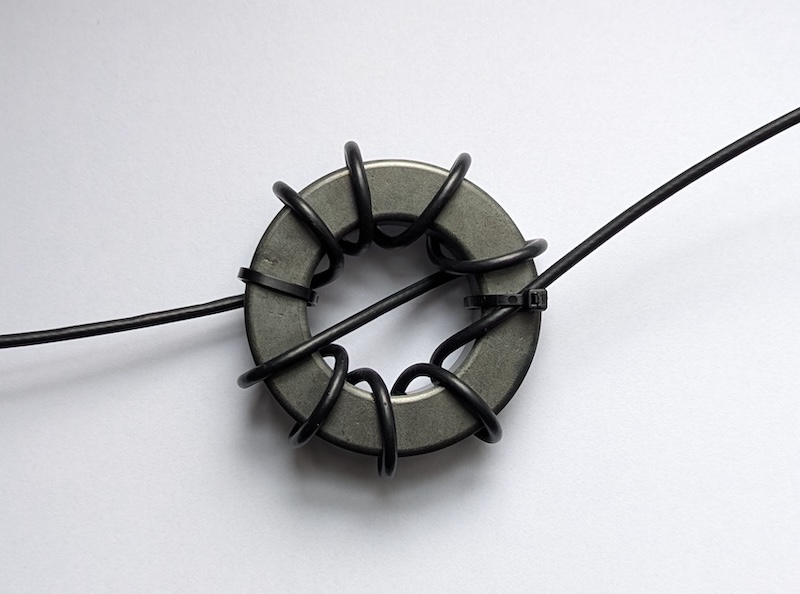
When I'm working portable, I mostly use the 20m band. The JPC-12 vertical antenna just isn't very good for NVIS propagation, which 40m usually favours. At home, however, 40m works really well and I worked Frank OV1CDX in Denmark and DK0SU in Germany before hearing old friend Paul G0OER calling CQ in the middle of a crowded band. We chatted for half an hour and although there were other stations very close and the noise levels were quite high, we both gave 599 reports. I was using 10W power.
Sunday 27 July 2025
I took my old schoolfriend, Dave, up to Carsington Water in the Peak District. He's been interested to see what my hobby entails but I don't think I can lure him into joining me. It was a bit of a thin afternoon as well. In over an hour we only bagged two stations, both from Finland: Jack OH3GZ and OM Erkki OH7QR, for the third time.
Saturday 26 July 2025
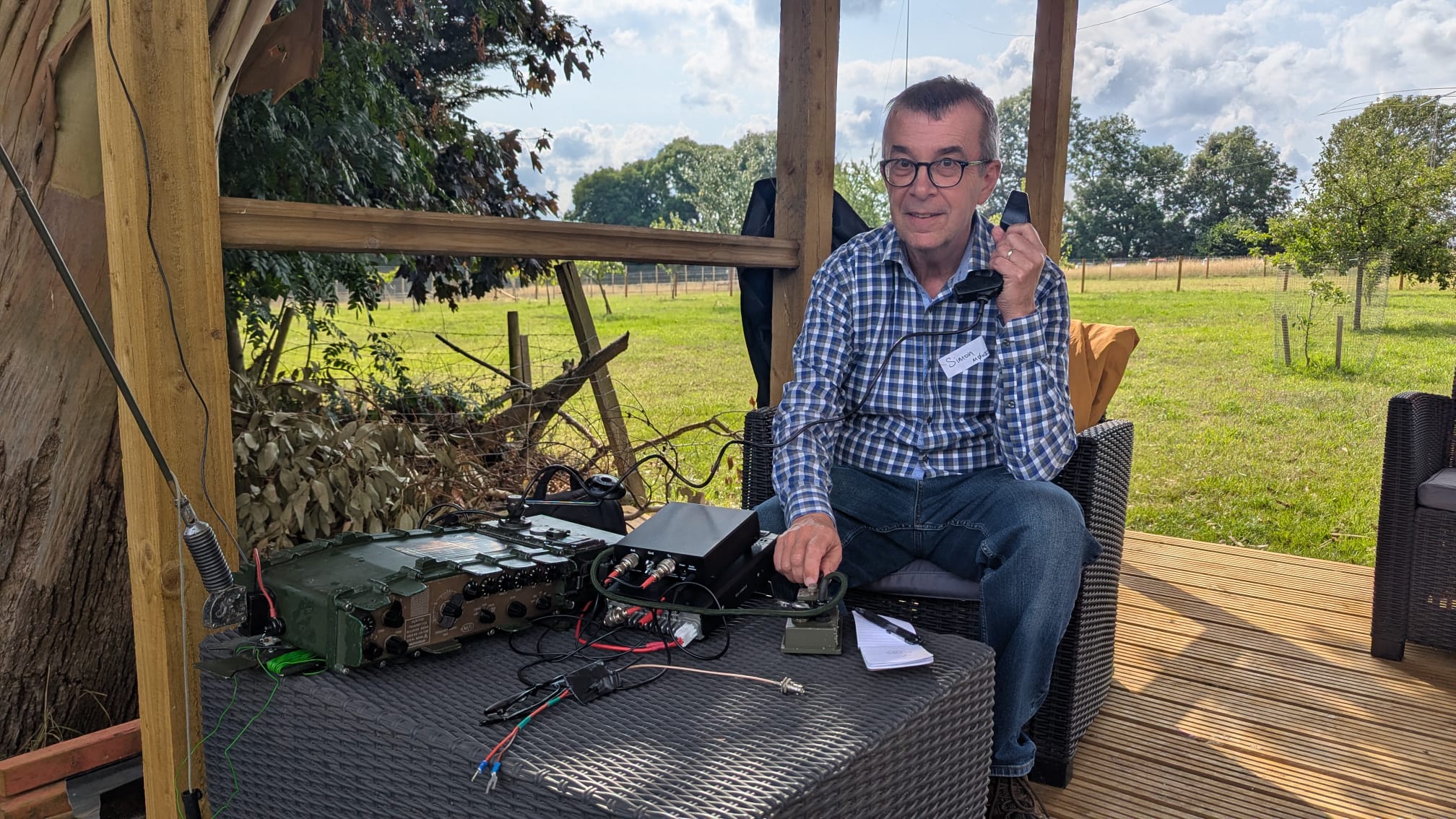
I joined fellow NRC volunteer Brian G4BIP at his home in Northamptonshire for a field day and barbecue with other NRC friends and with amateur radio operators from the BBC. It was an excellent afternoon and I enjoyed seeing Brian's impressive shack and rotatable beam antenna. One of his friends, Nick G0OQK had brought along his PRC 320 Clansman man portable military radio. It was exciting to see it in action and even better to get on the air myself, using the Clansman straight key to work Andrea I2TPC on the 17m band.
Wednesday 16 July 2025
I arrived at Cannock Chase again in the last hour before sunset. It's the first time that I have operated portable in the evening and with no breeze and after a warm day it was very pleasant. The bands were suprisingly quiet though. I only managed QSOs with Simon IU5RFA and Jozef OM4AFJ on 20m.
Tuesday 8 July 2025
Back to Cannock Chase again today to see if I could catch some of my Australian friends. Unfortunately, propagation wasn't great and I didn't succeed.
I was pleased to log a new country though, briefly working Z35M in North Macedonia.
Mike DL3YZ is a fellow member of the Australian CQ QRS group and it was good to make contact with him for more than a brief natter.
I finished with another ragchew with Jari OH2BFG in Finland and Vlad OK1KTI in Czech Republic.
When I got home, I did some analysis of my attempts to reach Australia each Tuesday. The full data can be seen here. Since 11 March I have operated on 14 out of 17 Tuesdays which yields enough data to make some interesting observations.
- Total days operating: 14
- Total hours operating: 15
- Total QSOs: 41
- Total VK/ZL QSOs: 6 VK2IOW (2), VK3DBD (2), VK2QI, VK3ACU
- Total EU QSOs: 34
- Total USA QSOs: 1
- Mean QSOs per day: 2.9
- Mean VK/ZL QSOs per day: 0.4
I had a VK/ZL QSO on 4 days out of 14.
3 of my 6 VK/ZL QSOs were on one day.
I made three quarters of DX QSOs from a coastal QTH. I used the same radio (Xiegu G90), power (20W) and antenna (JPC-12) for all attempts. I operated between 30 minutes and 3.5 hours after sunrise. I generally got more DX contacts when I operated closer to sunrise.
So here are my conclusions: I'm making fewer contacts than I would like. To achieve more reliable and consistent summertime DX, I would need to consider:
- getting up at 2am and driving over 2 hours to the coast for sunrise.
- buying an FT891 or similar 100W radio for portable operating.
- using a directional antenna with a substantial gain over my omnidirectional vertical ant.
In other words, I think I've reached the limits of what my current equipment will allow. There's no sense of failure here though. Amateur radio, like all technologies, has its limits. Yes, it's possible to transcend present limits with more investment but all that does is raise the limits. There's really no such thing as unlimited communication. A key part of my mindset is to embrace and enjoy the limits, rather than be frustrated by them. My persistence and limited equipment (and limited skill!) have all taken me to achieve the best that I can, within the limits of propagation and the limits of those listening on the other side of the world. It is a truly remarkable thing that we can communicate in this way and I am definitely not giving up. I will, however, take a pause from hunting DX.
Over the next months, I want to do more in the afternoons and evenings on various bands, which I think may be more fruitful. I also want to use my neglected QRP radio more and pick up my neglected coding and construction projects.
Friday 4 July 2025
I have only operated from home on one occasion since February. That's partly because I have had such a lot of fun getting out and about with my JPC-12 antenna. The other reason is that my half-size G5RV antenna had been giving me some trouble, making me think that I might have an intermittent cable failure.
Experimentation is a big part of the hobby for me so instead of simply fault-finding the G5RV, I thought I would try a 40m full-wave horizontal loop instead. These are reputed to handle local noise quite well. I erected poles at each corner of the garden so that the wire antenna could hang between 3m and 4m high.
It was great to see a 1:1 SWR but when I listened across the 40m and 20m bands, I heard consistently high levels of noise - about S7 on the radio's meter.
I did manage a very difficult QSO with but his signal faded into the noise and we only just completed it. It seems that the horizontal loop isn't going to work for me.
It's not really a big disappointment. The experiment was a success in that it reached a clear conclusion.
I turned back to my G5RV and quickly found that the source of my problems was a broken ribbon feeder. I had secured it to a gate post and the flexing caused by the wind led both solid copper conductors to break beneath the insulation. It took ten minutes to remake the fixing and the connection and I was pleased to return to an S3 to S4 noise level. It's not great but it will allow me to work from home when the weather is too poor for portable operating.
Tuesday 1 July 2025
How far would you go for a CW QSO?
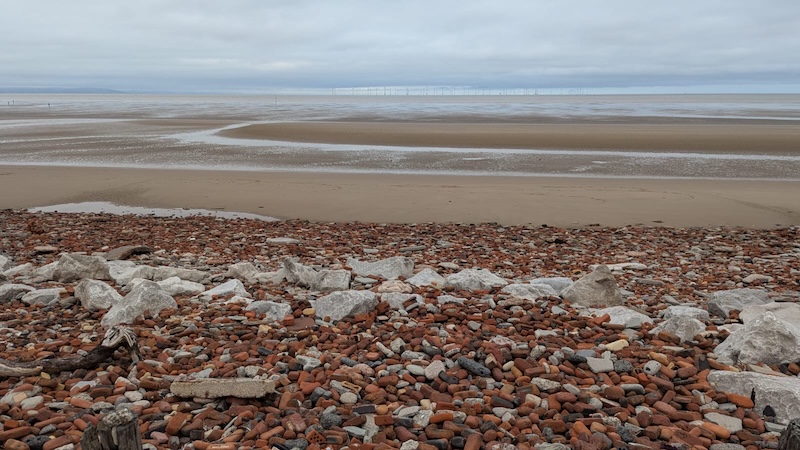
This morning I drove two hours to Crosby Beach at Blundellsands, north of Liverpool. I'd spotted the location on Google Maps and it looked promising - easy to access from the motorway and with a reasonably priced car park (£2.10 for four hours). Sure enough, I found a bench from which to operate and which also gave me the chance to say hello to passers-by, many of whom stopped for a chat about the mysterious form of communication that I was using. I enjoy these encounters with the public and often use my radio loudspeaker, rather than earphones.
Crosby Beach is home to Antony Gormley's remarkable Another Place sculpture. The low tide revealed more of the statues than I had seen on a previous visit. I saw another thought-provoking collection too. The shore is littered with bricks and rubble taken from the streets devastated in the 1940 Liverpool Blitz. The bricks and concrete have been tumbled by the waves into lovely rounded shapes.
Under a lead-grey sky, I called CQ, hoping to hear some friends in Australia. When Tom N4TTU replied from Athens, Georgia, I was thrilled. It's only two weeks since I made my very first QSO with an American station. Tom's CW was accurate and easy to copy. He told me he was using just 20W power and it made its way across the Atlantic very clearly. I was using 15W in return.
Kurt DF4FQ came in later with a much stronger signal, using 200W, telling me that even at 10am, his local temperatures had already reached 31C. It's been as warm as that in the south east of England today but I was thankful to be in a much cooler location.
I didn't catch any Australians today but finished up with Yves F5LIZ and Tom DL9DBI. Just four QSOs but very worthwhile.
Today's working conditions: Xiegu G90 radio running 15W into a JPC-12 antenna, Putikeeg Mini straight key.
Wednesday 25 June 2025
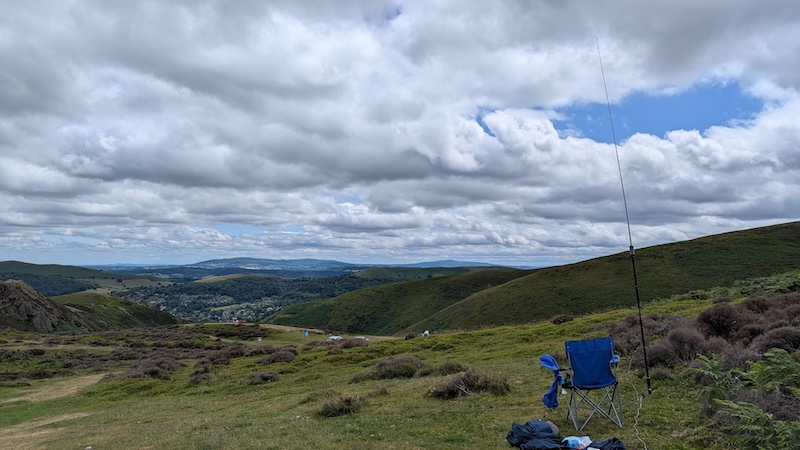
I have wanted to operate from the Long Mynd in the Shropshire Hills from the moment that I obtained my radio licence. I first went there as a teenager on a residential gliding holiday and loved the landscape. With nice warm weather and no wind, I spotted my chance and drove an hour from home to the Bur Way View Point car park. With only sheep for company, I climbed about 200m from the car and set up to work first on 20m and then on 40m, all using 10W.
HB9/DL1AIW/P was operating SOTA from the summit of Kronberg in Switzerland.
Klaus DM4TJ and Henk PA5BU were both running 100W and came through very clearly.
I worked Claudio IK4DRU for the second time in a week then dropped down to the 40m band to find G0FVH and Ben G4WDZ.
Modes used: CW. Equipment used: G90 radio running 10W, JPC-12 antenna, Putikeeg Mini straight key.
Tuesday 17 June 2025
Eight weeks ago I was operating from the shore of the Italian Riviera. It was a brilliant spot from which to work Australian friends but I hadn't been able to repeat the achievement since then. So it was a joy to hear Patrick VK2IOW's super clear signals this morning. I copied every word easily. His antenna was doing all the hard work. He could only give me a 329 signal report and it was very satisfying, despite being cut off after a few minutes when more powerful stations intruded on the frequency.
I returned to Italy with IK4DRU and then to Czechia with OK1LV.
Modes used: CW. Equipment used: G90 radio running 18W, JPC-12 antenna, Putikeeg Mini straight key.
Monday 16 June 2025
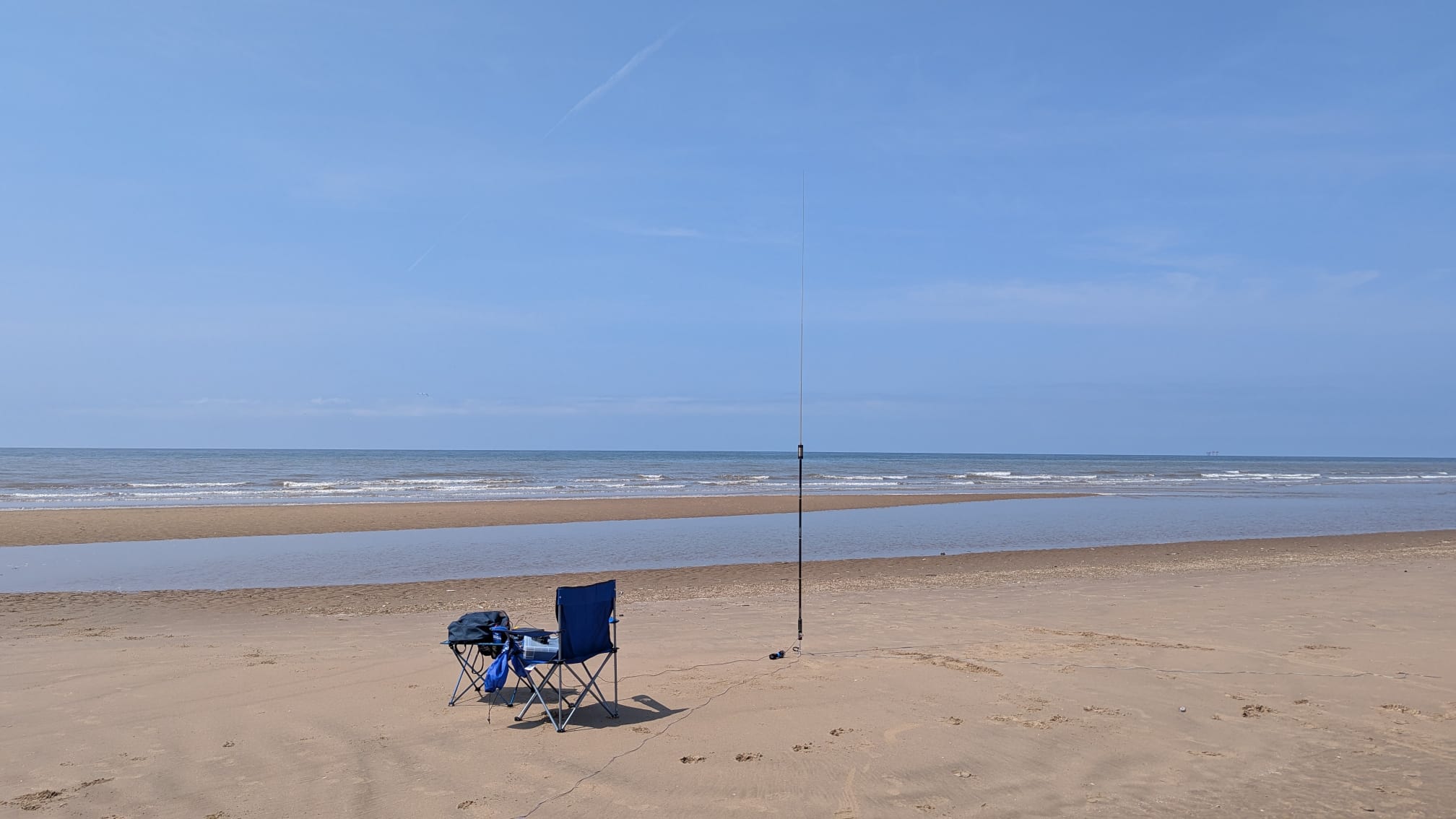
After 16 attempts, I finally managed to activate a POTA park. Ainsdale Sand Dunes GB-0348 is two hours from home. I had taken my wife to a conference in Liverpoool and packed the radio just in case there was an opportunity. It proved that it's worth keeping the rig and a charged battery in the car.
It couldn't have been a better location. There was ample parking about 300m from the beach. I set up on the firm sand near the water under a lovely sunny sky with barely any wind.
I spotted myself on the POTA app and started on the 20m band, soon chatting with DK3RED/P who was in World Wide Flora and Fauna location DLFF-0720.
After a pleasant QSO I noticed that the water was approaching fast. On this coast, the tides really race in and I quickly moved to a higher spot on the beach. From there I had a QSO with Thomas DM3TN who was doing really well with 5W QRP and a G5RV antenna.
I moved on to IK8YTA, S51RU, IU7BQV, Thomas SM3NRY and SV8/OK2PXJ, who told me that he was on a Greek beach with 5W power.
I had a chat with IN3NJB and then made my first QSO across the Atlantic, working K2UPD in New York State. Many of my friends regularly work the USA but I am usually on air in the mornings, which is incoveniently in the dead of night for the Americans.
Thrilled with this success and needing just one more QSO to qualify for a POTA activation, I switched to the 40m band and had QSOs with G0FMY and Geoff G4FKA.
It was a brilliant afternoon and all the better for being almost spontaneous.
Modes used: CW. Equipment used: G90 radio running 18W, JPC-12 antenna, Putikeeg Mini straight key.
Tuesday 10 June 2025
In poor conditions at Cannock Chase, I was very grateful to Durk DM2CLE who answered my CQ calls on a pretty dead band.
Tuesday 3 June 2025
The weather forecast for today was poor so I knew that I would be working from inside the car. It was only drizzling at Cannock Chase when I got there at 0645UTC and planted the antenna in the wet grass. Once I started operating however, the rain really came down. Fortunately, it all stopped just as I got ready to pack up at 0830UTC.
Following intense solar activity at the weekend, long-range DX was never going to be possible. The bands were quite quiet but I was pleased to get seven in the log:
Tom F4GOU, Greg UT2UN, CT1GFK, Raz IU1HCC, OK2JIQ, SM5DXT and HA7BJ.
Thanks to everyone who answered my calls. It confirms that it pays to call CQ on a quiet band.
Tuesday 27 May 2025
I tried Aqualate Mere Nature Reserve again this morning. As the weather was threatening rain, I operated from inside the car. It was comfortable but the drawback was that I had a poor mobile phone connection and couldn't spot myself on the POTA app. I heard my friend Chris G7BED in conversation with Drew VK3XU another chat between Mike DL3YZ and David VK3DBD but couldn't raise any Aussies myself. I got a very short QSO with IU5PTO that ended abruptly. It happens occasionally and always leaves me guessing. Did his gear malfunction? Did I send too fast?
It was nice to finish with Tom SP7BCA from Lodz in central Poland who sent with a beautifully steady fist. I could copy that all day long, thanks Tom.
The rain started to fall just as I packed away the last of my gear. I drove west into Wales to check out another couple of POTA locations, from which I may operate soon.
Tuesday 20 May 2025
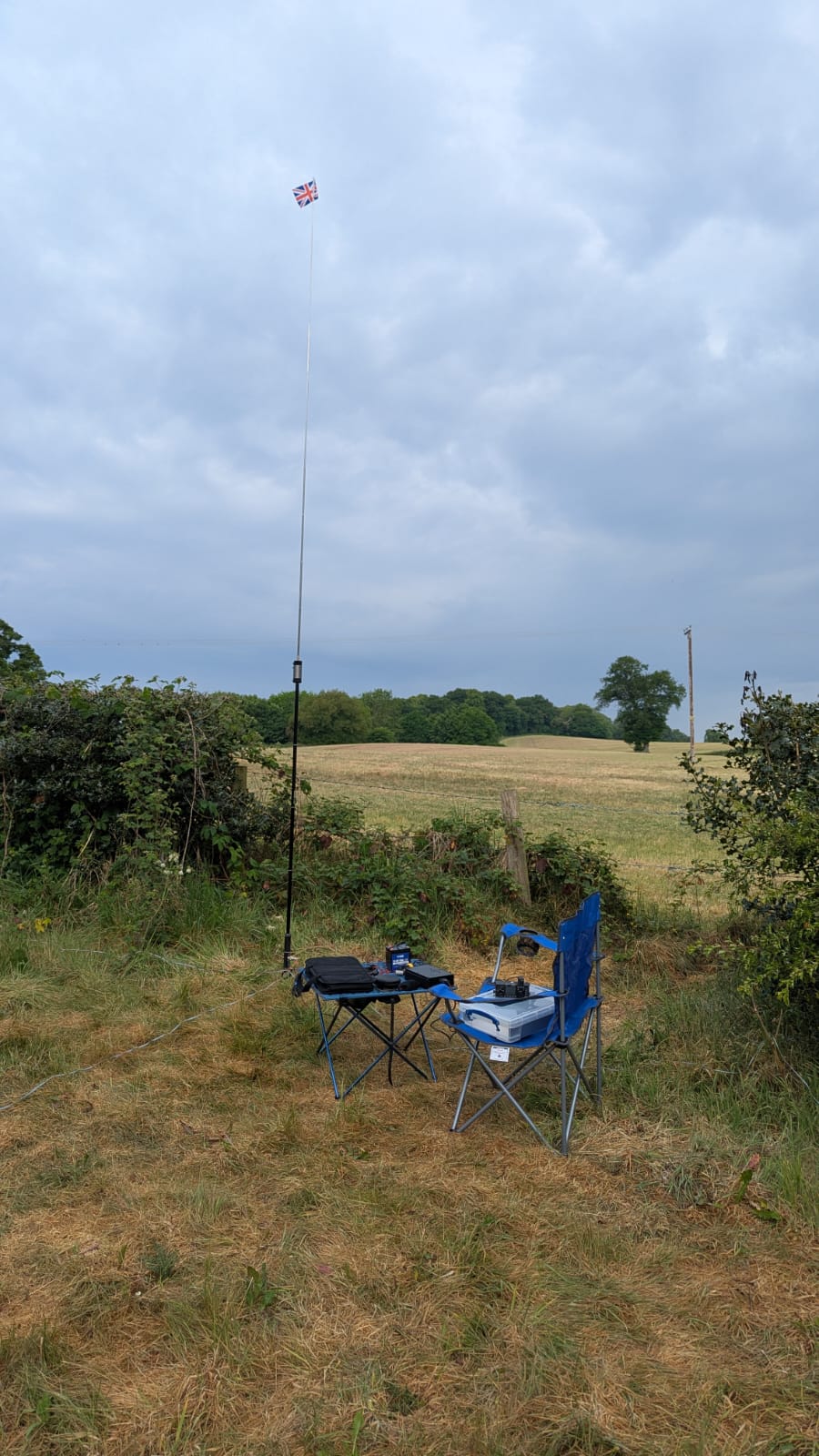
My first visit to Aqualate Mere Nature Reserve, which is POTA GB-0345. It can get frustrating calling CQ with a low power radio on a quiet midweek morning and getting no takers but by spotting myself on the POTA app, I hoped to attract more interest. It proved to be true. I made six contacts, before closing down so that I could get home in time for my gas boiler to be serviced.
On 20m, Karl OE3KAB, Luca IU8CNE, Giuliano IK8HCM (who was only using 2W power), CT1GFK.
and Marian SP4TKA.On 40m, G0FVH.
As time wasn't on my side, I operated from the car park but I will explore the reserve further next time and I'll make sure I stay long enough to get a POTA activation, which requires ten QSOs. The birdsong was lovely and as well as a skein of geese flying low above me, I was joined by two whirling red kites. The mobile phone connection was just about okay.
Wednesday 14 May 2025
It's not often that I operate without success but today was one of those barren days. The consolations were that the weather was beautiful and that I hadn't travelled far. I took my QCX+ and JPC-12 up to Northycote Farm Park, POTA reference GB-3734. Propagation was poor and although I heard a number of Italian stations, they couldn't copy me.
Tuesday 13 May 2025
I returned to Blithfield Reservoir on a fabulous morning. Not a cloud in the sky and very warm, without being uncomfortably hot. I was seeking QSOs with my friends in the Australian CQ QRS group but didn't find them. Never mind, I picked up some great contacts:
Jose EA1BIA in northern Spain on 20m.
Sal EA3BDE near Barcelona on 20m.
My pal Chris G7BED from the NRC on 40m.
Bruno HB9CBR/P on 20m. I had put away my Xiegu G90 and instead used my 5W QCX+ homebuilt radio. It was a QRP-QRP QSO. Bruno was using his Elecraft KX2 on Swiss mountain summit Wiseberg SOTA HB/BL-005.
Sunday 11 May 2025
Friends from the Wolverhampton Amateur Radio Society operated from the Wednesfield Royal British Legion and, as G8TA, I worked Erkki OH7QR, LZ75IPA and OT100R, all on 20m.
Saturday 10 May 2025
Before setting off on my trip to France and Italy in March, I took down my half-size G5RV antenna. I ordered jubilee clips to secure the sections of my push-up pole a little better and re-erected the antenna today. Despite poor conditions, I got Anton LZ3AN in the log on 17m and Glen G4DUC on 40m.
Tuesday 6 May 2025
I had a very slow morning at Cannock Chase. Propagation was poor and over a 90minute period I had no success making any contacts on 20m, 15m or 10m. All I got in the log was one 40m contact, EA1EX.
Sunday 27 April 2025
For my last operating abroad I chose the pretty village of Saint-Cirq-Lapopie on the Dordogne river. I first found Damian SP9LEE in Krakow, then Markus DC1MTS/P somewhere in Germany and then Gerhard OE6GJE in Austria. A group of half-a-dozen French people came to see what I was doing. My French isn't much better than my CW, so having to explain to them what was going on during my QSO was a real challenge!
I decided to change things up and tried the 15m band for the first time in a long while. I was amazed to hear the IARU commemoration station B100IARU from Beijing. It took him about ten tries to get my callsign but I'm 90% sure he did.
Finally, I made my first CW QSO with a Greek station SZ100IARU.
The whole trip was incredibly rewarding. I drove 4381 miles (7000km) over 42 days. I probably didn't do as much radio as I thought I would. I operated eleven times for a total of 31 QSOs. We were busy with sightseeing and I didn't want to ask my wife too often if she minded sitting in the car with a book. Despite the relatively low numbers, the experience was exceptional, especially the privilege of operating from Marconi's Villa Griffone.
Tuesday 22 April 2025
After huge success on the coast last week, I could barely reach anyone today as F/M0KBJ, from Meynes in Provence. The only station in the log was Petr OK1MGW in Prague. Propagation was poor.
Monday 21 April 2025
From the village of Blauzac in Provence, as F/M0KBJ/P I worked Keith G4OKT and Pavel OK1BIO/P.
Tuesday 15 April 2025
I hadn't successfully operated from the coast (see my abandoned effort on a windy Norfolk beach in 2024) but our next accommodation on the Ligurian coast at Imperia gave me the opportunity. With the Mediterranean Sea stretching towards the southern horizon, it was a perfect for reaching out to my Australian friends.
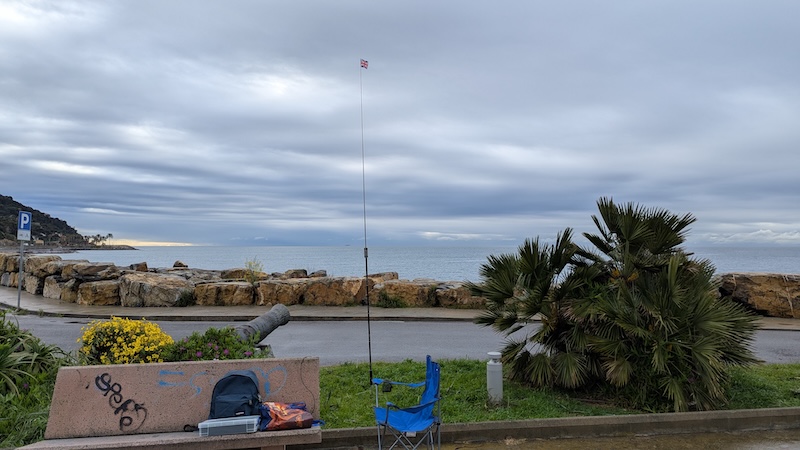
Sure enough, after first working Val UA1APX in St Petersburg, I bagged three in a row.
Jordan VK3ACU was only running 20W into an end-fed double-wave antenna but it was a sweet QSO.
Then it was David VK3DBD and Mark VK6QI.
Jordan even made a video with excerpts of our 20W to 20W portable-to-portable feat:
Sunday 13 April 2025
A huge thrill today. Not far from our accommodation in Bazzano, we visited Villa Griffone, the home of Guglielmo Marconi from where he conducted world-changing radio experiments in radio communication. His body is laid to rest in a mausoleum on the site and the house itself is now a wonderful museum. If there was anywhere that could be a shrine to radio, this is it.
I was really pleased to have secured a booking on a tour for my wife and me. On arrival we joined a group of around a hundred people, made up of Italian amateur radio enthusiasts from Tuscany and their families.
After checking in, we were invited into the lecture room for a twenty-minute presentation about Marconi's life and work. It was all in Italian but with lots of pictures, it was easy for us to follow.
The large group was then split into two for a guided tour. Our young guide was not a licensed amateur but he was exceptionally good. He took us to a room to demonstrate the science of radio using replica equipment. He pressed a straight key on a high shelf and a fat spark sizzled across a 50mm gap on top of a large induction coil. He then connected a receiving apparatus on the table in front of us and showed us a coherer, the primitive RF detector that Marconi famously improved with a self-resetting device. Now when he keyed the spark transmitter, the receiver rang out "SOS" on a brass bell on the table. He sent "CIAO" in Morse Code to demonstrate the inker, which printed the dots and dashes on a thin paper tape.
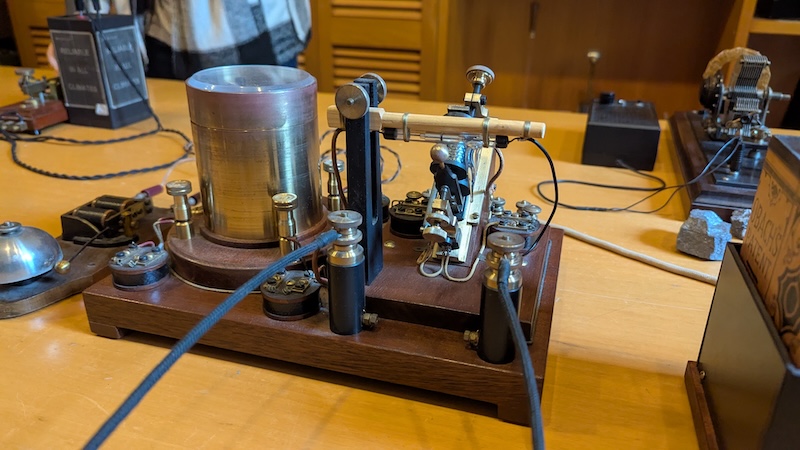
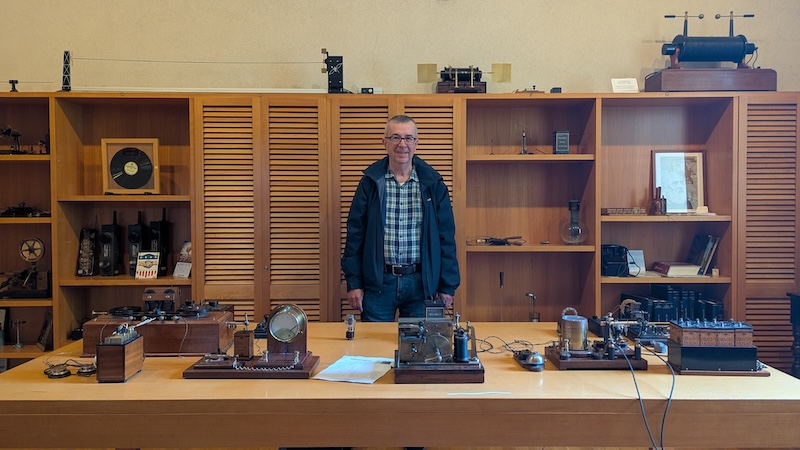
We were shown the silk room, in which Marconi did his research and a replica of a ship's Marconi Room, typical for the 1920s. After that, we were invited to play in an interactive area. I enjoyed using a spark transmitter to send sending Morse Code (not continuous wave!) to a receiver a few feet away.
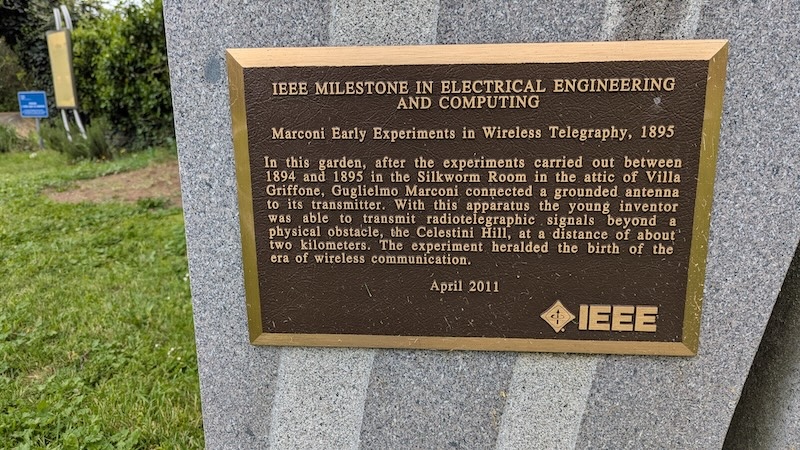
There was so much to see. I was also eager to emulate Marconi's consequential experiment of 1895, which is commemorated with a placque in the garden. To a companion two kilometres away on the other side of the Celestine Hill, Marconi sent a message to demonstrate the first non-line-of-sight radio communication. I asked for permission to emulate the feat, which was freely granted. I set up my radio under the silk room window. I switched on the radio and to my surprise and joy, I heard a spark transmission. Someone in the museum was sending "SOS" and I could see it across the waterfall on my G90. Since 1924, spark gap transmitters were banned from the amateur bands and in 1934 they were outlawed for all radio transmissions. There can't be many people alive today who have heard a Morse Code message sent as a spark gap transmission on their own radio receiver.
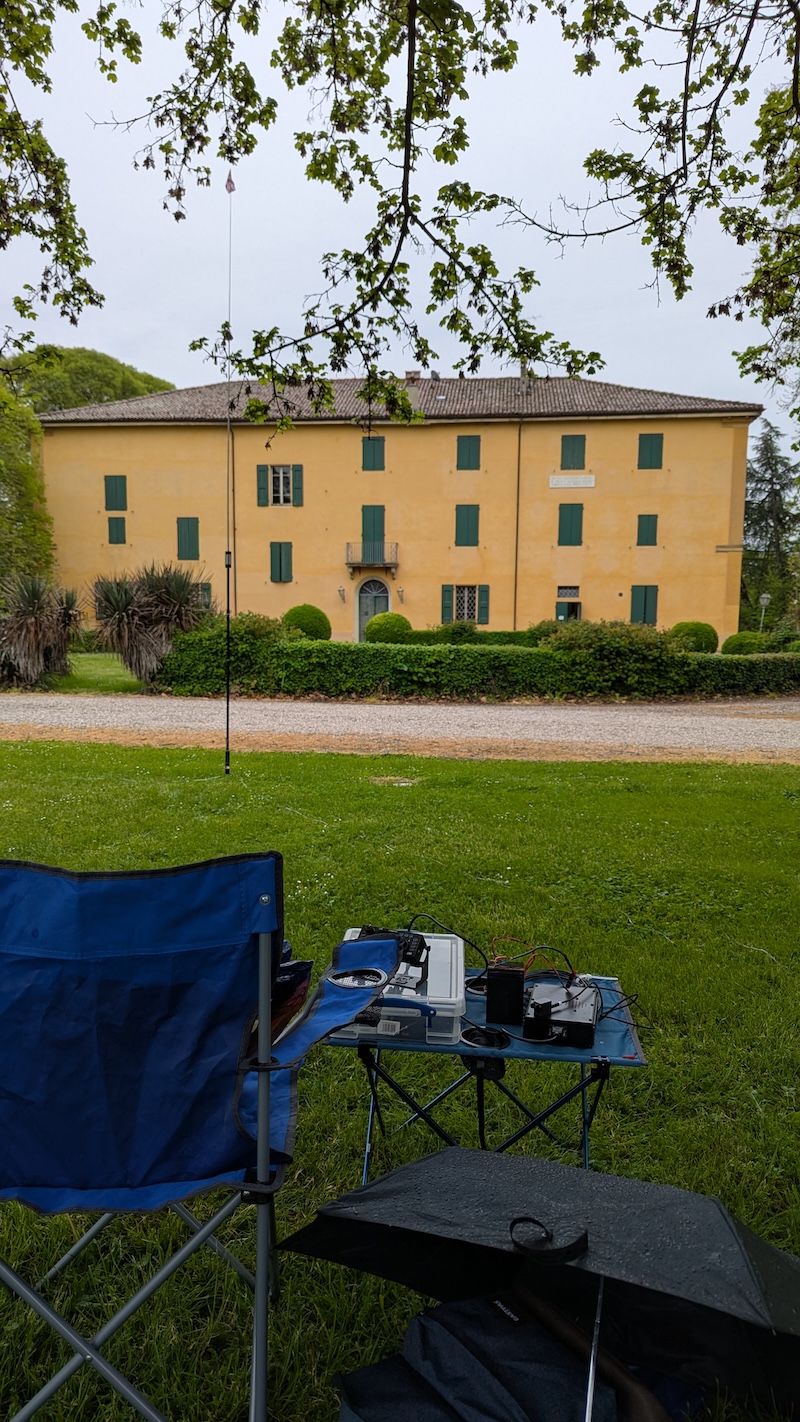
I needed to get a call out. I called CQ DE I4/M0KBJ and had pleasant exchanges with Brian G4BIP in Northamptonshire and Derek G4VWI in Leicester.
Friday 11 April 2025
From the Oasi di Manzolino nature reserve as I4/M0KBJ, I worked Rino IT9GNJ in Sicily.
Wednesday 9 April 2025
From Bazzano in Valsamoggia in the Emilia-Romagna region, as I4/M0KBJ I worked Andrew, operating as GB0IARU and Tom IZ4EKI. Incredibly, Tom was also in Bazzano, just a few kilometres away and my radio showed his signal as 40dB over S9.
I didn't get the name of portable station DF7TR/P before finishing up with Nano IU4AOZ in Firenze.
Tuesday 8 April 2025
From the car park of the disappointing Orto Botanico dell'Università Politecnica delle Marche near Ancona, as I6/M0KBJ, I worked Pete M5ABN in Devon and Max DM2MF in eastern Germany.
Tuesday 1 April 2025
I drove to an olive grove on the edge of the small hilltop town of Oliveto Citra in southern Italy for my regular rendevous with the Australian CQ QRS group, this time operating as I8/M0KBJ.
I was really pleased to have my first QSO with Mike DL3YZ who coordinates the small European branch of the group from Stuttgart and David VK3DBD in far away Victoria, Australia.
I finished up with Bora TA1UT in Istanbul and Bandi HA5AEK in Hungary.
Saturday 29 March 2025
After six overnight stops, I reached Latina, about an hour's drive south of Rome. As I0/M0KBJ, I worked Jerry PH9HB in the Netherlands, Damian SP9LEE/P in Poland, and two friends from the NRC: David G4TVH and Paddy G4MAD.
Monday 24 March 2025
From the garden of my bed and breakfast accommodation in Vienne in the French department of Isère, I set up for the 20m band, and called CQ DE F/M0KBJ. I worked Mykla US0RG and the Belgian IARU Society OP100A.
Friday 21 March 2025
I've always loved a road trip. Making my own way, rather being carried by an airline or train company, means I am actively involved in a journey. I enjoy the planning and meeting the challenges of navigation and endurance.
So, with a UK sticker on the back of my 1.2 litre Honda Jazz and my HAREC paperwork all in order to allow me to operate overseas, I set off for a grand tour of France and Italy. I took my Xiegu G90 and JPC-12 antenna, with a couple of keys and a 7Ah battery.
I thought I might get to operate from Portsdown Hill, which overlooks the city of Portsmouth. Alas, the rain set in and I decided that I didn't want to reach my ferry wearing soaking wet clothing, so I abandoned the attempt.
Tuesday 18 March 2025
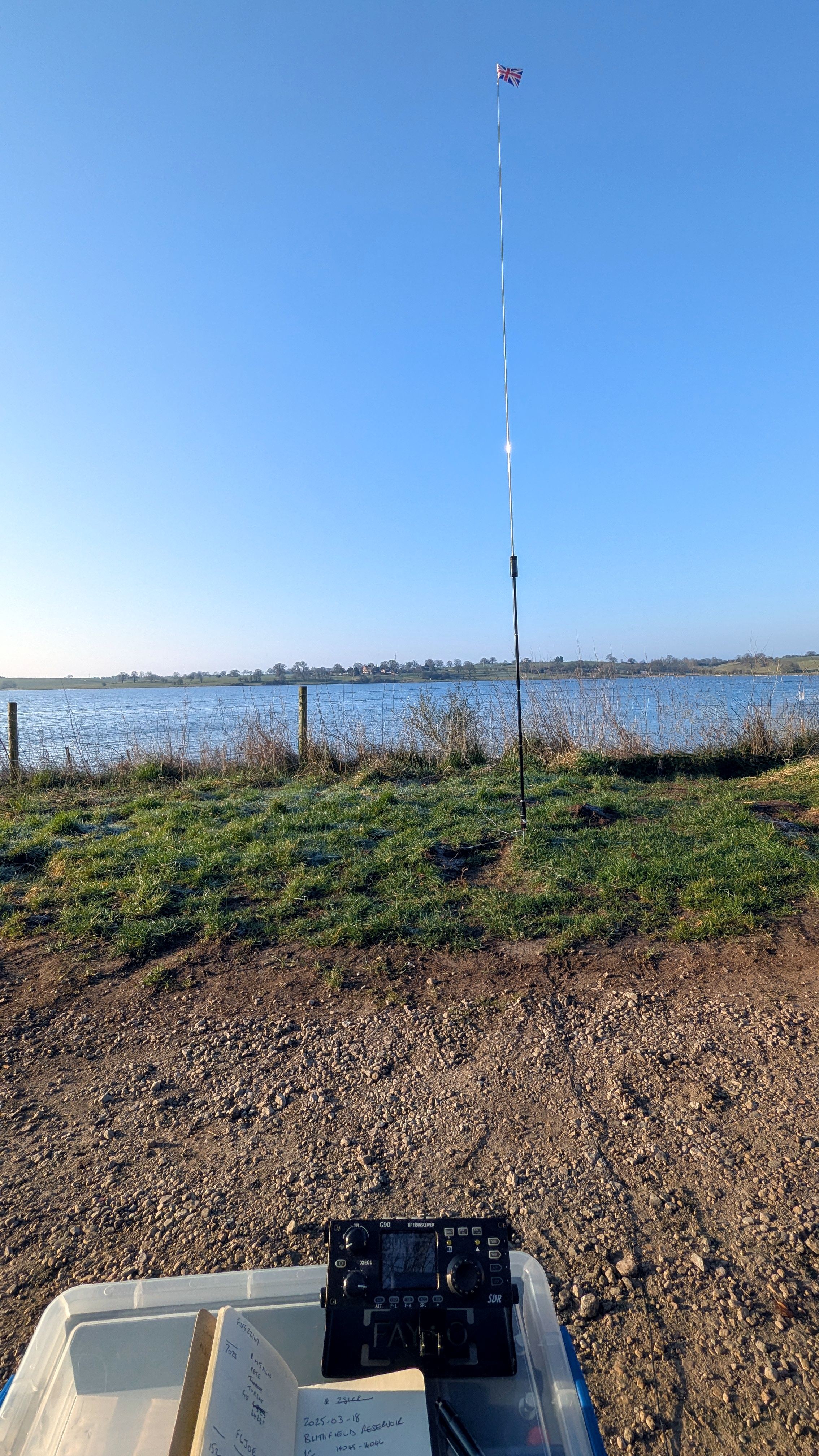
I was really pleased with a new QTH. The shore at Blithfield Reservoir, which happens to be POTA park GB-1648. I called CQ DX in the hope of reaching my Australian friends but didn't mind when Raca YU7RQ from Serbia and Paul DL6UEF from the eastern border of Germany answered for a chat.
I was more surprised to hear a UK station, the first I have worked on the 20m band. Despite the fact that the critical frequency was around 10MHz Clive G3NKQ gave me a 529 report and we managed a short QSO. I looked him up and found that he lives very near Graffam Water in Cambridgeshire, so I guess we both were using the water to our advantage.
The best thrill came with Patrick VK2IOW sending in a cracking signal with his 3-element Yagi. With no fading at all, we chatted away for a good thirty-five minutes.
I shall definitely return to this spot. It's a 40-minute drive from home, so a little further than Cannock Chase. But the extra effort is rewarded with a very peaceful scene and a great take-off for HF radio signals.
Tuesday 11 March 2025
I woke at six so that I could get to Cannock Chase in time to rendevous with Australian stations in the CQ QRS Group at 0800. The weather has really changed and in contrast to Sunday's shirtsleeve operations, today the temperature was just 2C.
I'm pretty quick at hooking up the JPC-12 antenna now and for this transglobal operation I chose to fly a union flag from it. The flag didn't bring me much luck though. I heard just one VK station - Mark VK2KI - and I had to keep dodging other Europeans who were calling over me. The CQ QRS - Alerts WhatsApp chat is very handy for letting people know where I was but my Xiegu G90 maxes out at 20W and that was just not good enough today.
My efforts were not entirely fruitless. From Slovenia Milan S58MU answered my CQ DX calls, followed by Val LY2BNL in Lithuania and Henry DL8NBG in Germany.
Back on 40m, I worked Peter G0GYY.
Sunday 9 March 2025
I had a great time at the National Radio Centre yesterday, making a dozen QSOs. I was pretty tired but decided the beautiful sunshine should not be wasted so set out looking for another quiet spot from which to operate. After a couple of likely places turned out to be unsuitable, I pitched up at a picnic site near the old Huntington Colliery. It had a lot going for it - good parking, a pleasant spot and low RF noise floor. The only thing against it was the traffic noise.
Under the oak trees, I joined the FISTS Ladder activity and found Phil 2E0DPH and Tony G3ZRJ on 40m.
I moved to 10m and had a quick QSO with LZ2SO but by then I was really fatigued, so I headed for home.
Thursday 6 March 2025
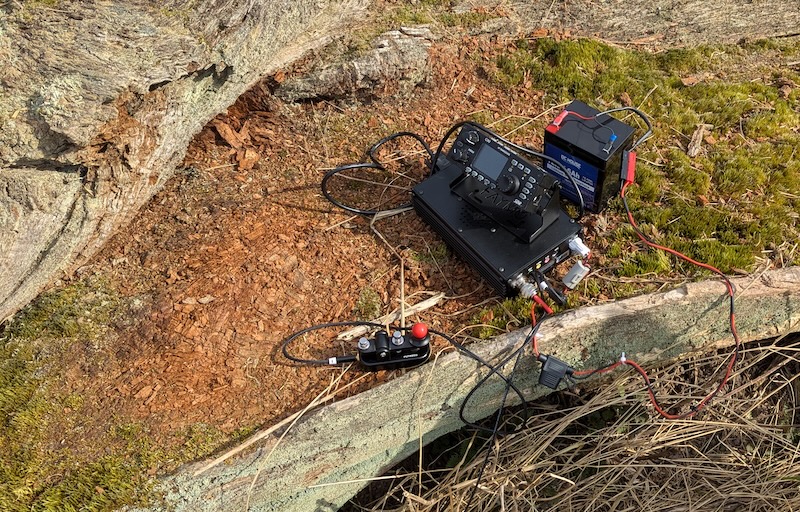
Having found that the nearby country park has a low noise floor, I set out today and made five very pleasant QSOs in sunshine that was so warm that I was able to sit in my shirtsleeves. The 20m band is reliable so I started there, working Fede IZ1AWE in northern Italy.
On the 40m band, my friends David and John answered my call from the National Radio Centre GB3RS. They were using a straight key and I could tell the difference between them.
David is a big fan of the 10m band. My half-size G5RV doesn't work very well for me on 10m so I was keen to find out what the JPC-12 could do. I was really pleased to see that my 10W signal was being picked up widely, including in Costa Rica. I had QSOs with Alex RA3RKG, Gennady RD3DN (both in Russia) and Kolyo LZ1DB in Bulgaria.
Tuesday 4 March 2025
Sunday's activity in the sunshine reminded me what I was missing in operating from home. Sure, it's really convenient to sit in a comfortable chair in a warm house and to get on the air within minutes. The laptop on my desk allows me to check callsigns on QRZ.com and to look around for signals on my favourite web-SDR and on the RBN CW Club Spotter. But one of the attractions of low power radio in CW mode is that it's elemental. It's an inconvenient way to communicate that exposes us to fundamentals. I have compared it to catching fish from a river with a rod, rather than picking up a fillet from a supermarket freezer.
Operating outdoors under a simple antenna under the sky that carries the signals for many miles without mains power or an interenet connection forces me to use very limited resources.
To enjoy all this though has entailed a 30-minute car journey to Cannock Chase. Wouldn't it be even nicer to do it locally, even within walking distance?
This led me to wonder how far away from housing I would need to be in order to get a really low noise floor. I looked at the satellite view in Google Maps and planned some experiments which I conducted yesterday.
At home with my half-size G5RV antenna, I have a noise floor of around S5 on both the 40m and 20m bands. I put up the JPC-12 antenna in the back garden and found that it produced about the same levels, plus a regular ticking QRM at a rate of about 2Hz. Vertical antennas are more prone to interference from household devices, so this was no great surprise.
I drove to a nearby playing field and set up the radio and antenna in its centre, which was around 100m from the houses and buildings that surrounded it. I was suprised to see that the noise levels weren't much better than at home: S5 on 40m and S3 on 20m.
I set off again and set up in a country park which is about 30 minutes walk from home. From the empty corner of a field where I planted my antenna,the nearest buildings are about 430m to the south. There is another street of houses to the east which are 500m away and one to the west which is about 700m away. Even better, there are large bearing ranges in which there are no buildings for up to 1km. I was absolutely delighted to find that on 40m the noise was S3 - perfectly workable - and practically S0 on 20m.
I'll definitely try this location for a proper radio session soon. And it's good to learn that I need to be around 500m away from housing to get a really low noise floor.
Sunday 2 March 2025
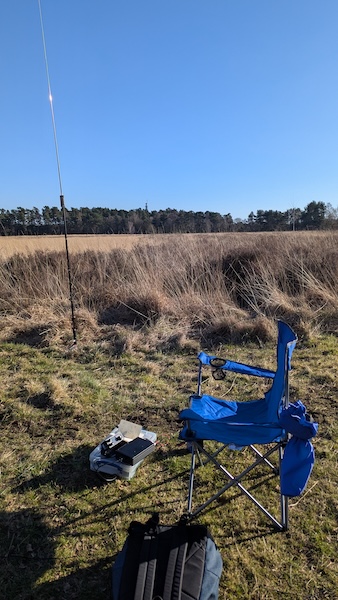
I verified that my new 10m length of RG174 coaxial cable works well by taking my radio gear out under a bright blue sky to Cannock Chase (POTA GB-0261) for the afternoon. It's about half an hour away from my home and the S0 noise floor is glorious. I can hear much weaker signals than I can pick up in (electrically) noisy Wolverhampton.
Even as I was setting up on the edge of the Aspen Car Park, a young couple appproached me and asked politely what I was doing. I relish these encounters with people who are curious and genuinely interested. We had a twenty-minute conversation about radio and about what led me into the hobby. It took no more than ten minutes to get everything plugged in and the JPC-12 antenna erected, so I was able to show them what signals I was able to pick up from the UK on 40m and around Europe on 20m.
Once I bade farewell to my visitors, Markus DC1MTS/P and I met on 40m. He was working portable from POTA park DE-0081, the Ohre-Drömling Biosphere Reserve, near Wolfsburg.
I retuned to 20m by sliding the loading coil along a little and worked another portable German station. Dieter DF1SDR/P was sending beautifully steady CW from Castle Ebersberg, near Stuttgart with his Yaesu FT857d and we chatted away for a good fifteen minutes.
Just one kHz down, IK1IYU/P had activated IT-0962, near the town of Asti in Northwest Italy, and we had a brief exchange.
It hadn't occurred to me to 'spot' myself on the POTA app. I haven't bothered before but it was clear that there were a number of POTA operators out and about on a Sunday afternoon. I called CQ POTA and was soon answered with brief exchanges with EA2DT, Helmut DF1RL and IS0HDP.
The coax and the new little Putikeeg mini key proved themselves and I shall look forward to doing more in the outdoors in 2025.
Friday 28 February 2025
Another afternoon of quality on 40m. First contact was Bryan G0GSY who told me that, like me, he enjoys playing with microcontrollers. His favourite is the ESP8266.
Next up was Ian G4HJM in Leicester, followed by another Ian G4MLW in York. His signal was one of the strongest that I've heard, pushing 90W from his Flex 6600 to produce a signal strength of S9 +30dB here.
Thursday 27 February 2025
I was sorry not to be able to understand Frank OV1CDX, who was too fast and didn't want to slow down or put any gaps between his words.
I had much better luck with Juergen DL4KAJ near Bonn who uses a G5RV antenna like me.
The big moment of the day came with a QSO with my friend John G4FZA. It was my 500th CW QSO and feels like another milestone.
Wednesday 26 February 2025
Many amateur radio operators have a wider interest in technology and its history. Andy was operating as GB9OCH to celebrate the 90th anniversary of the first experiments with radar. He was operating from one of the early Chain Home radar stations in Great Baddow, near Chelmsford.
It's always a pleasure to work new operators so up on the 20m band I found Manu IU6TPC working with a nice fist from near Ancona, Italy. According to his QRZ.com page, he has only been using CW since November 2024. He has made remarkable progress.
Finally, also on 20m, I worked Hans OE7AJI in central Austria, who was only using 5W power.
Tuesday 25 February 2025
I briefly thought about taking my radio out to work portable but thought twice about sitting still in the cold. So after lunch, I found Alan G0TAM on 40m.
I was pleased to get a new country in my log. Tony T77C from the principality of San Marino was calling on the 15m band, which I don't visit very often. It was a perfunctory exchange as he worked a long queue but nice to get his call in the log.
I finished with a very pleasant ragchew with Steve G0EAT in Holme on Spalding Moor, Yorkshire.
Sunday 23 February 2025
It's been a busy afternoon. We have very strong gusts of wind and before I could get on the air to join in the FISTS Ladder activity for the second time, I had to do some antenna repairs. I found that the telescopic pole which supports the central feedpoint of my half-size G5RV antenna had partially collapsed. It's not as dramatic as it sounds. The sections are tapered and rely on a tight fit to stay standing. One of them had slipped down, which meant that one leg of the antenna was sitting in the plastic gutter of the house. I had to disconnect everything and undo the clamps that hold the telescopic pole and I suspect I'll need to find a more solid way of securing it all.
Back in the house, I switched on at 1400 and worked four stations in an hour, three of them for the first time, beginning with Phil 2E0DPH in Ely. Next up was Bryan G0GSY in Cleethorpes, followed by Norbert ON4ANE in Belgium and lastly Rich M0RPA in Newcastle.
My operating was made a bit easier today as I have secured my WT 8Amp key to a small bamboo chopping board (£6 for a set of four from Lidl). This makes a surprising difference to the way I send with the straight key. I need to use less force and can be a little quicker.
Friday 21 February 2025
With friends at the NRC, John G4FZA organised a little gathering at 7036kHz this morning. Not quite a net but a friendly chance to meet on air. Conditions were excellent on the 40m band and all stations were 599 to me.
I moved along and, for the first time, worked Terry 2E0CWP near Durham. He was also using a straight key and has an excellent fist.
Thursday 20 February 2025
It's been quite a while since I worked old friend Keith EI5KJ in windy Wexford. He's my most worked station.
Monday 17 February 2025
I've been getting a little better with my Putikeeg mini straight key and worked three stations this afternoon.
First, DJ6UX on 40m.
Then, on 20m and from Schekino, south of Moscow, Alex RA3PMM followed by Genek SP3DGV in Przeclaw, Poland.
Incidentally, I've been playing with the Perplexity AI agent and have used it to help generate the HTML code for each of these blog entries from data extracted from my logbook. I wonder if anyone has connected a large-language model to a Morse generator for a QSO yet?
Friday 14 February 2025
I found John calling as GB3RS on 7035kHz this morning and we passed a few pleasant minutes before visitors came into the National Radio Centre at Bletchley Park. After me, he took a call from an old friend of mine, Paul G0OER. I listened and when they finished, suggested to Paul that we QSY up 1kHz. We chatted away for 15-20 minutes.
Later in the day, I QSO'd with John G0UBE over a distance of just ten miles.
Wednesday 12 February 2025
I'm in the habit of an hour of radio in the afternoons these days and today's effort was rewarded with two excellent QSOs. I found Steve G3ILO/P calling CQ from his narrowboat near Gloucester on the FISTS frequency 7028KHz. I moved up a couple of KHz and put out a CQ call which was answered by Cliff GI4CZW in Enniskillen. Cliff's style is really clear and I felt relaxed head-copying his code for a good 20 minutes. We both lamented the grotty weather that we have at the moment. Both Northern Ireland and the English Midlands are sitting under high pressure. I told Cliff that I'm looking forward to some warmer weather when I travel later this year and that I will be taking my radio with me. We might even be able to arrange a QSO.
Tuesday 11 February 2025
Two really nice straight key, 5W QSOs on 40m this lunchtime. Richard G4TPJ in Tonbridge, Kent, sent fairly brisk but perfect code. It was as fast as I can head-copy at the moment, probably around 17-18wpm but the clarity and accuracy of his sending meant that I got every word. When we finished, Mike M6MPC came on and used his distinctive bug key from the Peak District.
Monday 10 February 2025
On 40m with a straight key, I passed a very pleasant hour in the company GM4HBG, Steve PA2A and Chris G3XVL. It was Chris who introduced me to the FISTS Ladder activity yesterday. I'm keen to do it again in a couple of weeks.
Sunday 9 February 2025
I have been a member of the FISTS Group for quite a while (member number 22169). They hold a relaxed 'ladder' activity with two, two-hour sessions on the second and fourth Sundays in the month. I made three QSOs with other FISTS members today: Chris G3XVL in Suffolk, Pete M5ABN in Torbay and Bryan G0GSY near Grimsby, all using my straight key. According to the rules, that would have gained me 9 points. I haven't done anything remotely competitive in radio. The fast and furious contests don't interest me at all but the FISTS Ladder sounds good.
Wednesday 5 February 2025
Just a quick exchange with DA0FWK,the committee for the Wattenscheider carnival in the Ruhr Valley, followed by a very pleasant fourth chat with Alan G0TAM in North Norfolk.
Monday 3 February 2025
I'm enjoying the straight key at the moment and to get more live practice I made three QSOs this afternoon on the 40m band. First using 5W with Didy DM2BRF in Dresden then, with just 1W, my namesake Simon GOFOZ in Christchurch, Dorset and finally with Horst DK4AC near Hannover. Horst lost my 1W signal in the QRM as someone else was operating close to our frequency but when I powered up to 10W he had no difficulty.
Friday 31 January 2025
I had the special honour this afternoon to work Larry Bennett who was using special callsign GB1GKA to commemorate the centenary of the Portishead Radio Station. Larry worked as a radio operator from 1980 to 2000 and his code was a joy to listen to. I thought it apt to use a straight key as well but my fist is very shaky. This recording is a good comparison of a vastly experienced operator with expert skills and a rookie like me.
Wednesday 29 January 2025
Just one quick QSO today. Another call with the National Radio Centre at Bletchley Park GB3RS. This time, Mike was on the straight key on 7020kHz.
Tuesday 28 January 2025
I sometimes use the HamAlert app to let me know when some of my favourite operators are on the air. It works by using data from the CW skimmers that are run by operators all around the world.
This morning it alerted me to the fact that GB3RS was calling CQ on 7020kHz, so I turned on the radio. Today's operator was Brian, who kindly dropped his pace so that we could have a QSO. The NRC was quiet and there weren't any visitors in the radio room at the time.
Brian moved on to other frequencies and after our chat ended, I was called by Gerald G3MCK. It's the second time that we made contact and his 40W signal from Rutland was very clear and strong.
Sunday 26 January 2025
I made my 500th QSO using my Xiegu G90 radio this afternoon. I worked Drew G0CZE, in Hertforshire, who was using his clever 95AN solid state paddle. It was great that this special occasion was a proper ragchew rather than a perfunctory exchange. Our chat was only curtailed when Drew told me he had to go out in the sleet.
When the opportunity came up to buy the G90 in a silent key sale in April 2023, I was a bit unsure about it. At that time, I was learning CW but hadn't had the courage to get on the air. I hadn't even made an HF QSO from my own home before. I thought that the G90 would be a good introductory radio which I could try out to see if the amateur radio hobby was really for me. With a very small budget, I went ahead hopefully and it becaame an early 60th birthday present from my wife. It's a decision which I have never regretted.
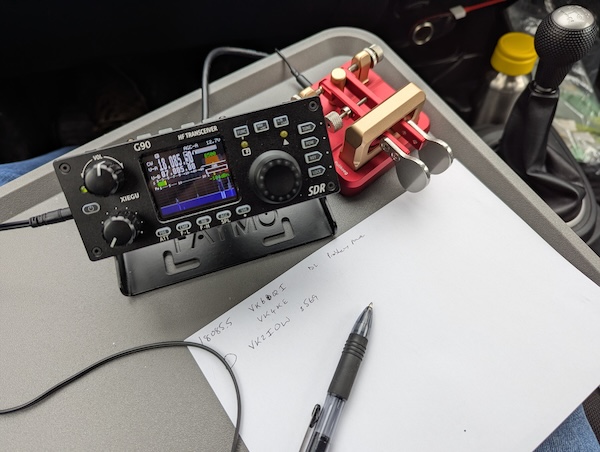
The G90 has a software defined radio (SDR) architecture. This means that most of the signal processing is done digitally. The user interface is through a detachable control deck which has three knobs and twelve multifunction pushbuttons to adjust various settings. They're a bit fiddly but as it's the only radio I regularly use, I quickly mastered them. Until a few months ago, I kept the controls integrated with the main body but I now really enjoy having a tiny device on my desk. Even when working portably, I find that separating the control deck from the radio is ideal. I can angle the screen towards me using a mounting bracket that was designed for under-the-dashboard mounting in a vehicle.
The maximum output power is 20W, which is plenty for CW. Youtuber Walt K4OGO uses voice only but he loves the G90 so much he made a video about the purchase of a second:
Xiegu releases new software from time to time. Mine is still runing version 1.73. which seems fine to me. Later versions changed the setting of the filters, which has hindered CW operation acconding to some.
So will I be trading in my G90 for a bigger rig? No, it really does everything that I need.
Saturday 25 January 2025
Welcome to the Putikeeg Mini straight key, which joined my stable today. I christened it with a QSO on 14058.5kHz with Raz IU1HCC who was operating with his straight key from his home in Savona, on Italy's beautiful Ligurian coast.
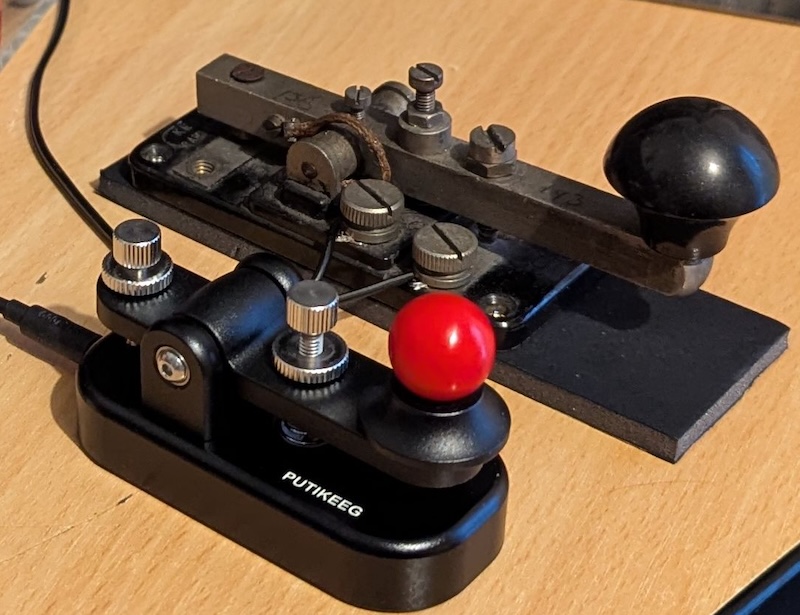
The Mini will be perfect for portable operating. It's going to take some getting used to but I'm impressed with the quality of its cast metal construction. It's finished in a matte black which makes the bright red spherical knob really pop.
Before the excitement of getting to grips with a new key, I worked old friend Marco IU4PTG in Modena and new-to-me Alex HB9DTA in Lugano, Switzerland. As soon as I heard Alex's signal, I knew he wasn't using a modern transceiver. Sure enough, he told me that he has a 1980s Italian ELMER military radio with 20W power. I liked its characterful tone.
Thursday 23 January 2025
On my favourite 40m band, I began with Wim PD0HRS for a very pleasant chat and then had a good call with Jean F6GNG in Rouen.
Wednesday 22 January 2025
A little more time today, so I began with a chat with Martin EI2IAB, who's doing well to master the key.
I stayed on 40m for a first qso with Kieran G8HCB near Bromley in South East London and then finished with Roy OP5K near Antwerp.
Tuesday 21 January 2025
I popped onto 20m to work Ray DG4FDQ near Frankfurt.
Monday 20 January 2025
Just a quick one on 40m today. Alan G0TAM near Cromer with a very steady fist.
Friday 17 January 2025
You often hear that CW operators are the most encouraging and patient. That may not be universally true but the four that I worked today were excellent examples who show that there may just be something in this stereotype.
After a week on the straight key, I picked up my lovely Putikeeg heavy duty paddle and tuned the G90 on the 40m band looking for some friendly contacts.
Conditions were excellent and I heard Lindsay G3VNT and Alan G0TAM having a nice chat. I followed on to talk with Lindsay and then, after a very pleasant chat with Richard G0MIE in Glouscester, Alan andswered my CQ call.
I fancied a change, so dropped onto the 20m band where the conversations tend to be more brief but with operators who are farther away. I was delighted that Pierre F5LLY answered my CQ call. Although his signal was quiet, his code was flawless and was easy to copy. He lives at the foot of the French Alps, which I am visiting in a few months. He very kindly said that I am welcome to pay him a visit when I take my radio on a long adventure in a couple of months.
I've been thinking through how I will operate and what I will need for my trip. It will be good to be able to use both a paddle and a straight key, so I have decided to buy another Putikeeg. This time, it's the small but perfectly formed Morse Mini.
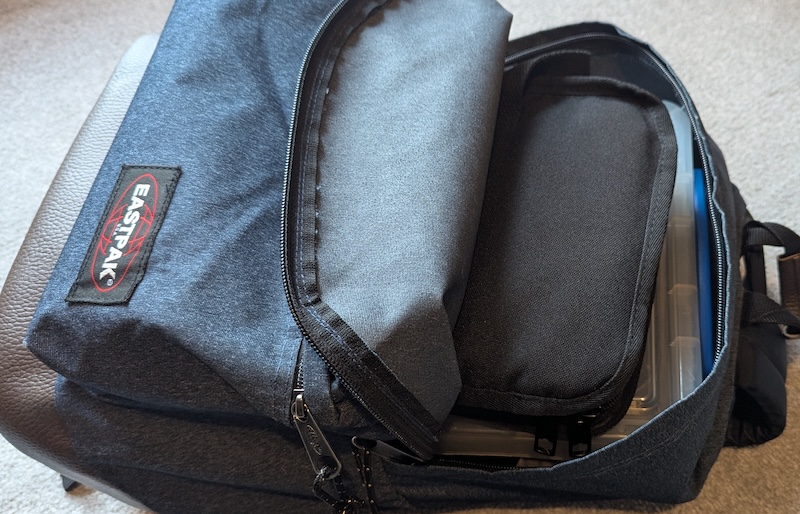
The gear that I use for working portable will need to be compact and safely packed so I have been looking at storage options. I'm really pleased to have found a neat way of arranging everything to fit in a small backpack which I already own.
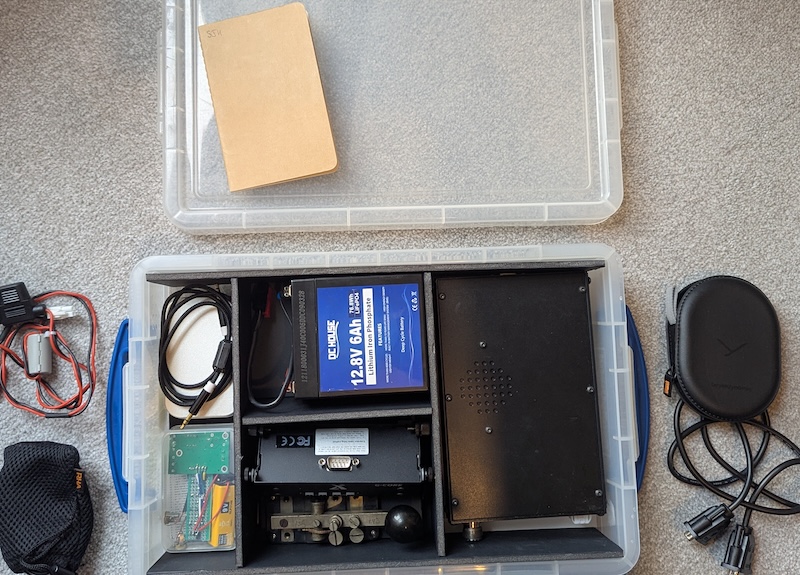
The JPC-12 antenna has its own carry bag and I can stash the 10m length of RG58 coax inside. The bag fits in the backpack along with a 4 litre plastic storage box that contains everything else.
Wednesday 15 January 2025
I'm slowly getting the hang of the straight key as my muscle memory improves. Over the course of an hour I ragchewed with Alan G3ZIK in Bolton and, for the fourth time, with Ian G4HJM in Leicester.
I have worked out a simple system for noting down the essentials on paper, which I can transfer to the log that I keep on Google Sheets. My new system isn't foolproof but I use two rows on a sheet of plain paper to record them in a consistent sequence:
Time Callsign RST (received)
Frequency Name RST (sent)
Underneath these I write any other information that I want to record, including the operator's location, working conditions etc.
Tuesday 14 January 2025
Where does the time go? I've been practising copying using both the Morse Code World Word Trainer and by listening to a web-SDR but I thought I should fire up the radio again. I've been enjoying practising with my straight key too, so I used it on 40m for an hour to work David M7LLH, who has held his licence for just under a year, and Ian M7OPR, who was licensed in 2023. It's great that new operators like us are using CW as our main mode. Until 2003, passing a 12 words-per-minute Morse test was part of the licensing requirement for operating on the HF bands. I'm sure this requirement led many people to resent CW and led them to drop it as soon as they could. Now it's purely voluntary, I'm hearing that it's seeing a little resurgence.
Tuesday 7 January 2025
One of my goals for 2025 was to make a contact over 1000 miles away using 1W power. Well, I achieved it in the first week of the year!
To my joy, Vilius (Willy) LY2PX heard me when I replied to his call on 20m. I was so excited I botched his callsign several times before I sent it correctly. Willy lives in Vilnius, 1121 miles (1800km) from Wolverhampton.
Before that, I had a nice chat, also on 1W, with Jean ON5DE on the 40m band.
Saturday 4 January 2025
Another enjoyable shift volunteering at the National Radio Centre. The cold weather and threat of snow later in the day kept visitor numbers down but we still had really good conversations and engagement with those who came. I made ten QSOs as GB3RS, many of them with visitors alongside who were fascinated to see how we use SSB and CW on the HF bands and on the satellite station.
Wednesday 1 January 2025
The new year is off to a flying start on tiny power levels, which have become my favourite thing. Peter DL9EBA was doing well to copy my 1W signal with a 319 report. Horst DL9FI was using 2W from Saarbrucken, which made our QSO my lowest total-power contact to date. Back on 40m I chatted with Steve M0STN for the third time. His IC-705 sounding very nice indeed and worth every penny of its 5W output.