About my adventures in amateur radio
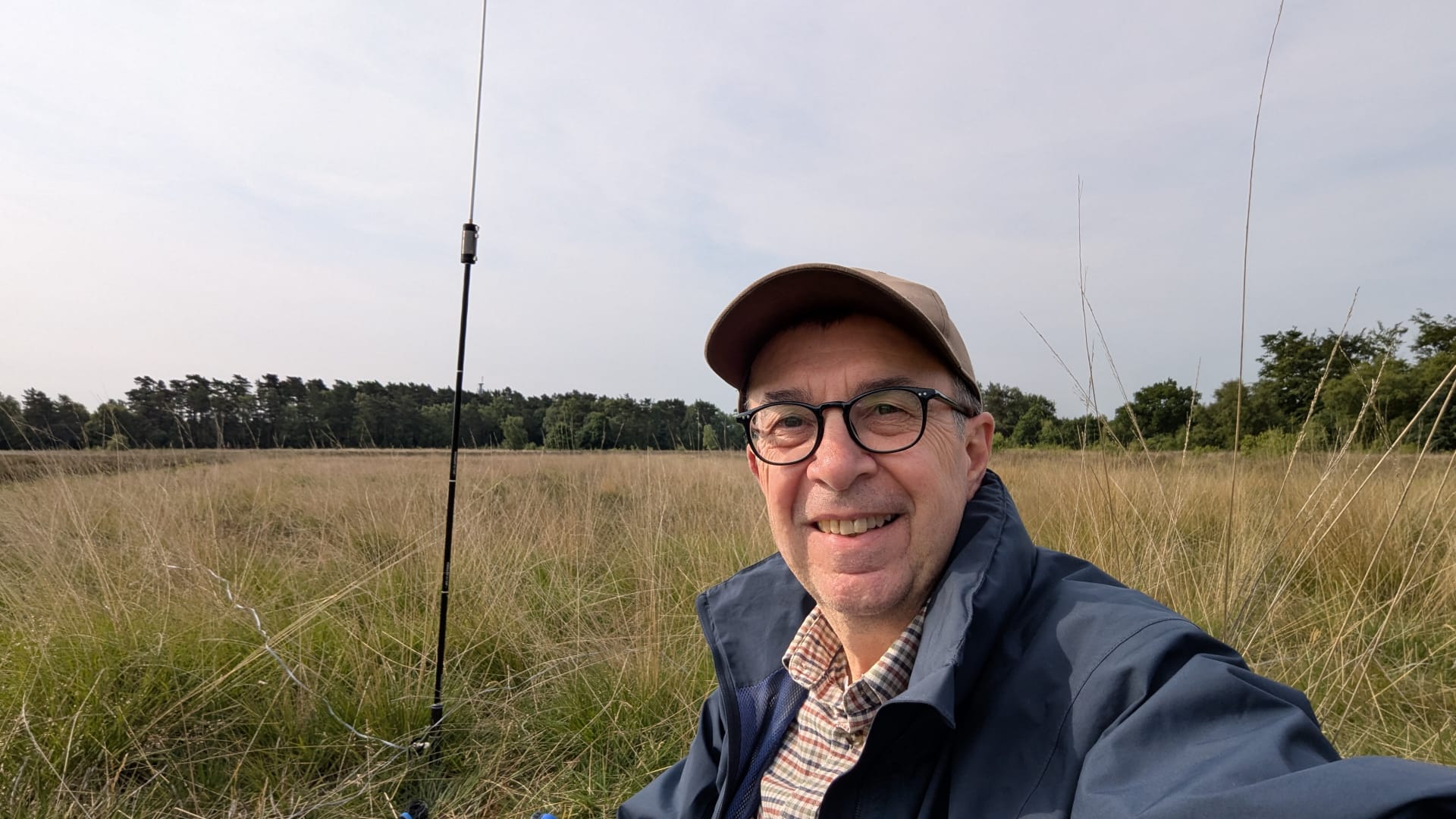
A little about me, my specific interests in the amateur radio hobby and my equipment. On this page:
- Why keep a blog of the log?
- How I started in amateur radio
- Learning CW
- Working with fundamentals
- What is amateur radio?
- Personal milestones
- Philosophy
- Equipment
- Logging and QSL cards
Why keep a blog of the log?
Keeping a log has been part of amateur radio since its beginnings. In the age of experimentation, precisely recording operating conditions and performance was vital to research. This original purpose of the log is still important to me and these pages record my tinkering and trials, what works and what doesn't. Sharing these experiments on the blog is a way of offering my experience to others. I find that writing down what I am doing shapes my intention and makes my projects a little more purposeful.
A second specific purpose of the log is to record when transmissions are made, including those which don't result in a contact. This was a sensible precaution when interference with neighbours' TV and radio equipment wasn't uncommon. An amateur could use their log to see whether or not their transmissions coincided with someone's spoilt viewing. It is no longer a requirement of the licensing conditions and since the power output that I use is extremely unlikely to cause interference, it's not something I do as a matter of course.
Most importantly for me, a log records the contacts that I make. Some operators don't bother making records at all. Others note the barest details. I prefer to jot down a few notes about the person that I contacted. I'm fascinated by other people's stories and always look up contacts on QRZ.com. If I glean any more details in the course of a QSO, I make a note.
Writing this blog makes me a little more appreciative of the people with whom I chat. They become more than a callsign and even if they only get the briefest mention, it somehow feels that I've done justice to the fact of our contact.
Quite often I will follow up a QSO with an email and referring to the blog is a bit like sending a QSL card to confirm the contact.
I suppose it's worth recording what this blog is not for: I'm not hoping that it will be widely read and I've no desire to build an audience. The final purpose is personal, I happen to like having a permanent record of my evolving hobby.
How I started in amateur radio
Following a suprisingly early retirement in 2022, I moved back to my home city, Wolverhampton. I found that the Wolverhampton Amateur Radio Society meets very near to my new home and, at the age of 59, I decided to try amateur radio as a hobby.
I began as most people do, with a 2m/70cms handheld radio. I struggled to make many contacts despite trying new antennas and felt that I needed to get on the HF bands. Besides, my greatest interest was in learning to operate in Morse Code (CW).
I very much enjoyed the learning that went with obtaining the licences, so within three months I passed my foundation, intermediate and full licence exams.
Since 11 September 2022 I have been operating as M0KBJ. The logs on these pages were made with this callsign unless otherwise stated, almost all of them in CW mode.
For me at least, radio is more of a pursuit than a pastime, requiring some intention and dedication to master skills and gain knowledge. It has been worth the effort.
Learning CW
I taught myself CW using a small number of tools:
- Morse Code World - an excellent and flexible online trainer
- Morse Code Ninja - huge amounts of training materials in MP3 and video with thoughtful articles about the learning process
- Ditto CW app for Android
- Morse Mentor app for Android
Learning CW is not easy. I guess there's some variation between people and I am sure that it's a skill that can be mastered better when one is young but I doubt that anyone who has ever got to a reasonable standard has found it undemanding. Part of the attraction for me is that the rewards are hard-won, requiring more effort, discipline and commitment than I am used to putting into a hobby. It requires more patience than intellect. At times it has been a struggle, though I have realised that if one isn't enjoying the process, it's better to take a break. I remember in some weeks I somehow gained a significant boost in proficiency, then finding myself unable to make more progress for a while.
I logged my first CW QSOs in June 2023 and it is the most enjoyable part of the hobby for me. CW operators are almost always willing to slow to my pace and are incredibly encouraging to newcomers. The learning curve is steep and long—but who wants a hobby to be easy? The challenge is what makes it all worthwhile and with other people to help us on our way, it's a very satisfying adventure.
For more background, my location and my club membership numbers etc, see my QRZ.com profile.
Working with fundamentals
In keeping with my passion for CW, I also like working with fundamentals. That's why I keep this page as clean and simple as possible. All the content is hand-coded static HTML. You won't find any fancy scripting here and it doesn't rely on a flashy content management system. With any luck, it should last a while. I started the page in October 2024 and uploaded previous QSOs from my Google Sheet logbook. I also love writing in Markdown, for which my current favourite tool is Typora, so I sometimes start a draft in Markdown and use Pandoc to convert it to HTML.
What is amateur radio?
Amateur radio, sometimes known as "ham radio", allows licensed hobbyists to use a wide range of radio frequencies for learning and for fun.
Amateurs have often pioneered technical aspects of radio since its early days at the start of the 20th Century. I prefer to use Morse code on the high frequency bands but others enjoy using a microphone or digital messaging modes. It's possible to spend a lot of money on powerful and sophisticated stations but I like to keep things simple and cheap, using gear that costs a few hundred pounds at most. In the UK, the Radio Society of Great Britain has supported the hobby for over 100 years and its website provides much more information.
The appeal of the hobby for me is in the way that I can apply new knowledge to the essential human need for communication. When I'm using simple equipment to communicate hundreds or thousands of miles, even across the whole world, without any of the internet's complicated, trillion-dollar infrastructure, it puts a smile on my face.
Personal milestones
Follow the date links to be taken to the relevant blog entry.2022-05-21 Made the decision to start the amateur radio hobby. Started thinking about learning Morse Code too.
2022-06-03 Received a Senhaix 8600 handheld VHF/UHF radio for a birthday present.
2022-06-08 Passed my Foundation Licence exam.
2022-06-10 Obtained my first callsign, M7DLJ.
2022-06-12 Made my first radio contact.
2022-06-20 Started learning CW.
2022-07-12 Passed my Intermediate Licence exam.
2022-07-15 Obtained callsign 2E0HZB.
2022-09-06 Passed my Full Licence exam.
2022-09-08 Obtained callsign M0KBJ.
2023-04-13 I made my first HF contact and first with my own callsign M0KBJ, using my first HF radio, the Xiegu G90.
2023-06-28 I made my first CW contact.
2024-01-12 Started volunteering at the National Radio Centre.
2024-03-17 Made my 100th CW contact.
2024-10-03 First VK (Australia) contact.
2024-11-06 First ZL (New Zealand) contact.
2024-12-11 First QSO using 1W power.
2025-03-24 First time operating overseas.
2025-04-13 Operated from Marconi's home at Villa Griffone.
2026-02-21 Bought Kenwood TS-530SP
2026-02-24 14,000 mile LP contact with Japan
Philosophy
The rewards in every hobby are intrinsic. Pleasure comes from the satisfaction, delight and even joy that arises as one does it.
Of course, I'm pleased that the hobby has allowed me to volunteer in various ways which benefit other people. I'm glad too that my presence on the airwaves makes it possible for others to participate. But if I'm honest, these are not the main reasons that I am an amateur radio operator. The real reason is the simple pleasure of a rewarding pastime.
A gardener or an angler might pass on the fruit of their hobby to others but they will obtain delight from simply tending the soil or sitting on a riverbank. So it is, for me, with radio.
A number of features in this hobby just work for me.
The chief of these is the opportunity for learning. I very much enjoy exploring technical topics and my curiosity in science and engineering has been part of who I am for as long as I can remember. I like to know not just how things work but why, gaining some expertise along the way. Radio and its associated technologies have allowed me to understand topics and to apply them through experimentation, design and construction.
The second is closely related. I enjoy being creative. Some amateur radio operators use equipment that just works. This is sometimes described perjoratively as off-the-shelf appliances but I don't criticize anyone who wants to buy, for example, a handheld radio that lets them talk with people far and wide. Most off-the-shelf radios offer a some scope for altering settings and general tinkering, so their use does require more effort than a mobile phone. But I want to go much further than this, trying out new things and especially through designing and building equipment of my own.
Third, I very much enjoy working within demanding constraints. For example, in July 2025, I described reaching the limits of what my current equipment would allow in communicating with Australian stations with no sense of defeat. Amateur radio, like all technologies, has its limits. Yes, it's possible to transcend present limits with more investment but all that does is raise those limits. There's really no such thing as unlimited communication. A key part of my mindset is to embrace and enjoy the limits, rather than be frustrated by them. My persistence and limited equipment (and limited skill!) have all taken me to achieve the best that I can, within the limits of propagation and the limits of those listening on the other side of the world. I recognise that limits force innovation, demanding that I am as resourceful and creative as I can be. That feels like fun!
Applying all of the above means working to a strict budget of a few hundred pounds a year. I get joy from acquiring new things and there's no doubt that I would be thrilled to have a dream radio costing thousands. But I still get a buzz when a tiny package arrives with a component which has cost me under a tenner.
Lastly, I have hugely enjoyed mastering the skills necessary for operating in CW mode. I don't play a musical instrument or sport, so learning to copy and send code has given me the chance to gain proficiency with my hand as well as my brain.
Equipment
I have encountered many who enjoy the hobby for the opportunities that it brings for curating a collection of equipment. The profile pages of many stations on QRZ.com feature photographs of transceivers which are impressive both in their specification and in their sheer number. A friend in my local club doesn't operate much but told me that he has at least a dozen radios. Amateur musicians are sometimes teased for their gear acquisition syndrome and that's an accusation that could be fairly levelled at a high proportion of radio amateurs.
I can understand the appeal. In a technically difficult hobby, superior equipment enables the operator to achieve more. Even if the improvements that a new radio brings over an existing radio are practically minute, the allure can be irrestistible. It would be quite possible to spend more time doing research about the next purchase and discussing the merits of a certain item in online groups or in the local club than actually operating on the air.
I have just two radios, one home antenna and one portable antenna. Apart from a small number of Morse keys, there's very little else. I could fit my entire station, even its antennas into a suitcase. If you're reading this to see a fine collection of gear, I'm sorry to disappoint.
The old-fashioned term used by amateurs to describe their radio set-up is "operating conditions". This conveys the fact that the whole signal chain, from Morse key to antenna forms one complete system. I have learned that it's important to think about the whole station, rather than focussing on one item in isolation.
Since getting on the air in 2022 I have wanted to explore different bands and techniques, while operating exclusively on CW. I have made two essential choices:
- Using multiple bands
- Operating from home (a base station) and and portably
These choices led me to choose a versatile antenna and a versatile transceiver. With the limitations of my budget, I inevitably chose low-power operating. I was fortunate to start the hobby as the peak of the solar cycle approached so, despite the inevitable compromises, I have been able to get on bands from 40m to 10m and to make DX contacts as well as chat with locals.
My current home station comprises:
- Desktop straight and paddle Morse keys
- Kenwood TS-530SP transceiver with Kenwood AT-230 antenna tuner.
- 20W multi-band Xiegu G90 transceiver
- Feed line and balun
- half-size ("junior") G5RV antenna
- Some accessories
It allows me to to operate on 40m to 12m and is chiefly limited by local noise on receive and by output power. The output power of the radio is further reduced by feed line losses. The G5RV is a non-resonant antenna and while the G90 radio can match a relatively high SWR at its output, the losses in the feed-line can be significant. Even with full output from the radio, I expect that I am radiating no more than a handful of watts on some frequencies.
I find that I can work nearly all the stations that I hear on the 40m band and around half of those that I can hear on the 20m band. A higher output power at the feed point would increase that proportion so adding a remote antenna matching unit or using a resonant antenna instead of the G5RV could be helpful, especially as the solar cycle fades.
My portable station comprises:
- Lightweight straight key and paddle Morse keys
- 20W multi-band Xiegu G90 transceiver
- Feed line and balun
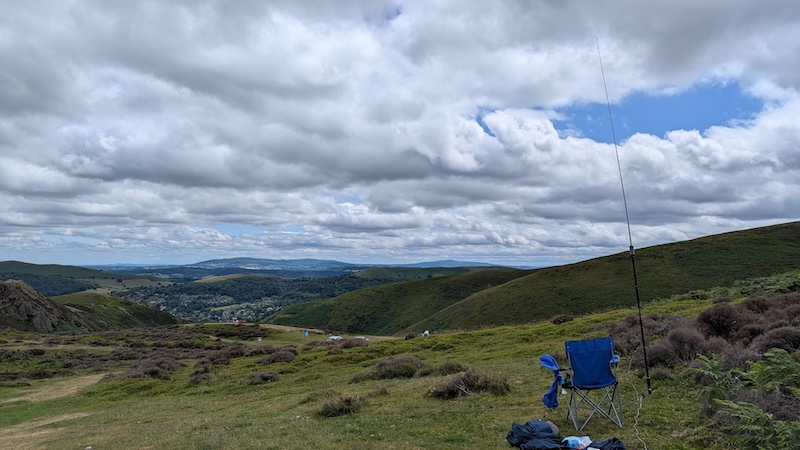
- JPC-12 telescopic whip antenna
- Some accessories
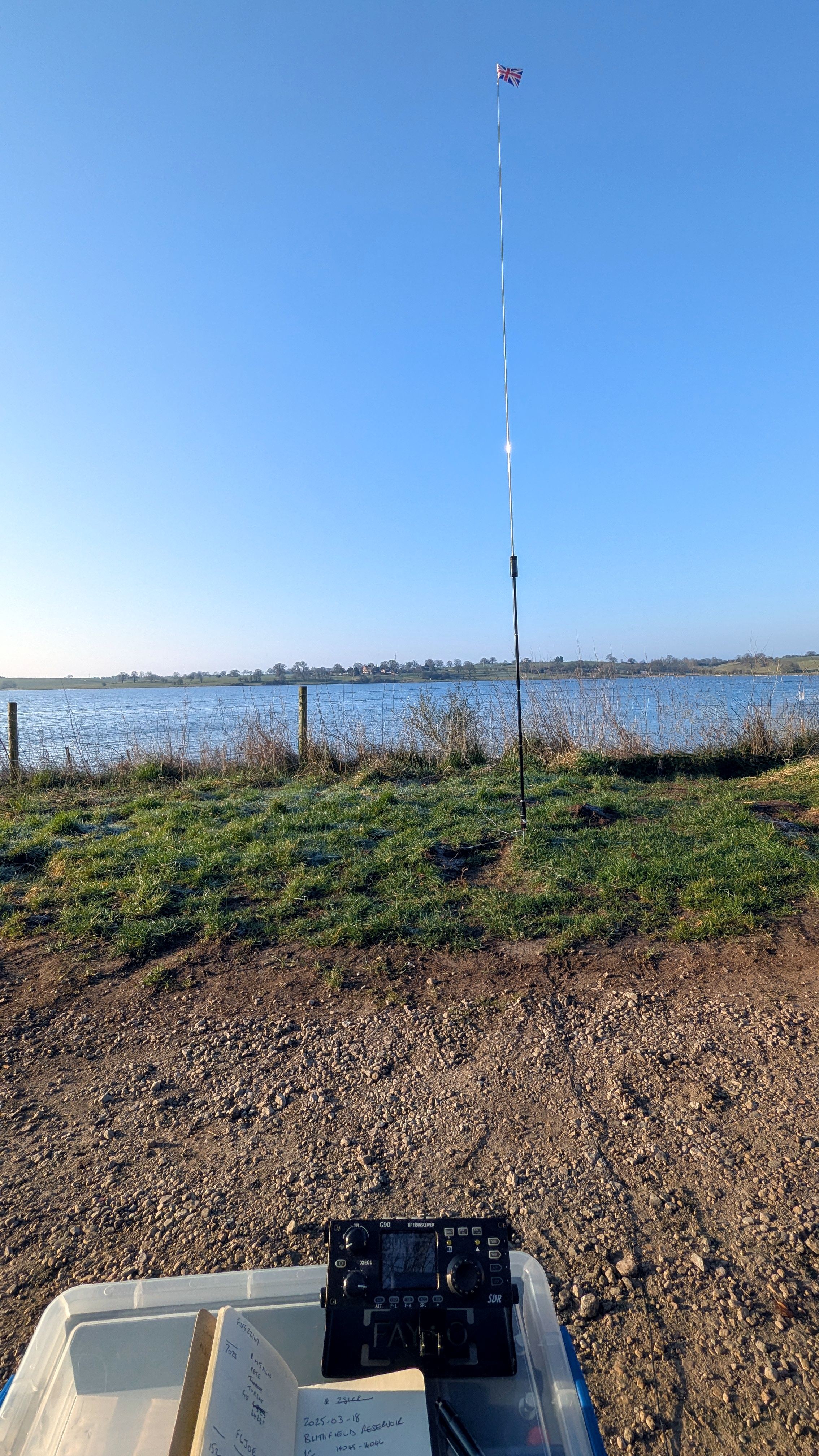
The JPC-12 is very easy to deploy and I have successfully used it to work stations in Australia on 20m and in the USA on 10m. It's less effective for local ("inter-G") use on the 40m band because it radiates at low angles.
Morse keys
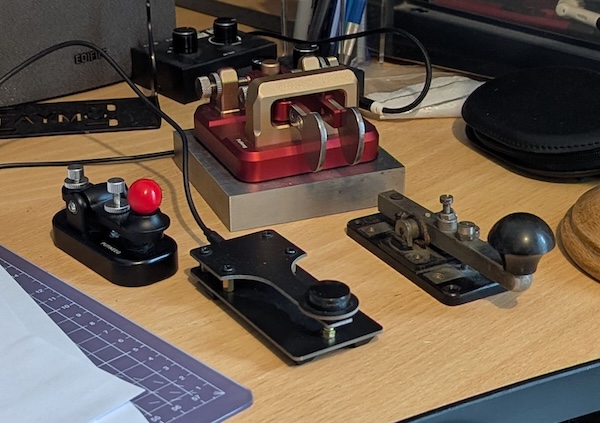
I enjoy using both straight keys and paddles. The simplicity of the straight key appeals to me and I like the way that its signal bears some of the operator's personality. Modulating a carrier wave by turning it on and off through the manual action of making and breaking a contact is the most fundamental means of radio communication.
If a straight key is like handwriting, then using a paddle is like typing on a keyboard. I like using a paddle, just as I like to type, and it's satisfying to send well-formed code. Do I have a preference? Not really, I tend to spend some weeks on one style of key then switch to the other.
When using a paddle, I always use iambic keying, squeezing the key to produce not just chains of dits and dahs but alternating streams when the characters require it. I just don't see the point of using a paddle by slapping it for every dit and dah. I learned and much prefer iambic mode A and can't understand why mode B still exists (see this splendid article by Karl Fischer DJ5IL for a comprehensive explanation).
- As I started with Morse Code in 2022, my first straight key was the Kanga Products FPK Flat Pack Key. It's an elegantly simple design, comprising two printed circuit boards. The flexing of the top board allows the contact to be made and broken. There are no springs, magnets or bearings. It cost me just £7 and took just a few minutes to build. I discovered that it's not a great key for an outright beginner but I'm glad to have it and it works very well as an input device for my Morse-based electronic projects.
- I learned to send Morse with a cheap QU-7025 paddle from Ali Express for £20. I used it for eighteen months before I got frustrated with its flimsiness.
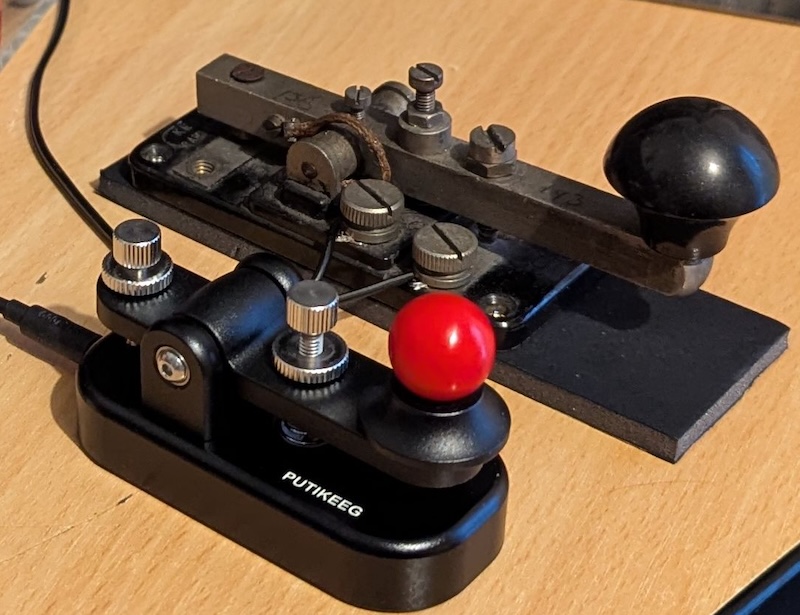
- In February 2024, I invested £84 in the Putikeeg heavy duty paddle and I have been really pleased with it. It has strong magnets on the base so I have mounted it on a solid steel jeweller's block, which gives it real presence as well as stability. The contact spacing has a fine adjustment and rarely needs resetting. It uses a magnetic return which works well. The paddles are widely spaced which may not suit some people but I find the overall performance is just as good as Begali paddle that I use at the NRC.
- In April 2024, I splashed out a tenner on eBay on a WT 8Amp key inside a Nato YA8414 SOR classroom training unit. These were made from 1940 or earlier and well after the war too. Each student would have a unit which enclosed the ubiquitous British army WT-8amp key with sockets for linking to a tutor's training unit and to a handset for speech operation. My friend John G4FZA recalls teaching students using exactly the same equipment. The enclosure took up too much desk space so I removed the key and mounted it on a wooden board. It has worked well enough but I'm looking forward to my next straight key.
- For Christmas 2024, my wife bought me a UMPP-1 miniature paddle made by Peter GM0EUL. It's a tiny key but the magnets on the base hold it firmly on my radio's metal enclosure. The action feels very different from the full-size paddle but it works well enough.
- In January 2025 I spent £34 on the Putikeeg Mini straight key, mainly for portable use. It's serviceable but the short arm makes the action a bit tedious and imprecise. The contact spacing also requires frequent adjustment so overall it's not a pleasurable key to use. Nevertheless, out in the field it has done its job adequately and I have taken it places that I would not want to use a more expensive key. I recently compressed the spring completely after taking it out of the key. It's made the action lighter, which I prefer.
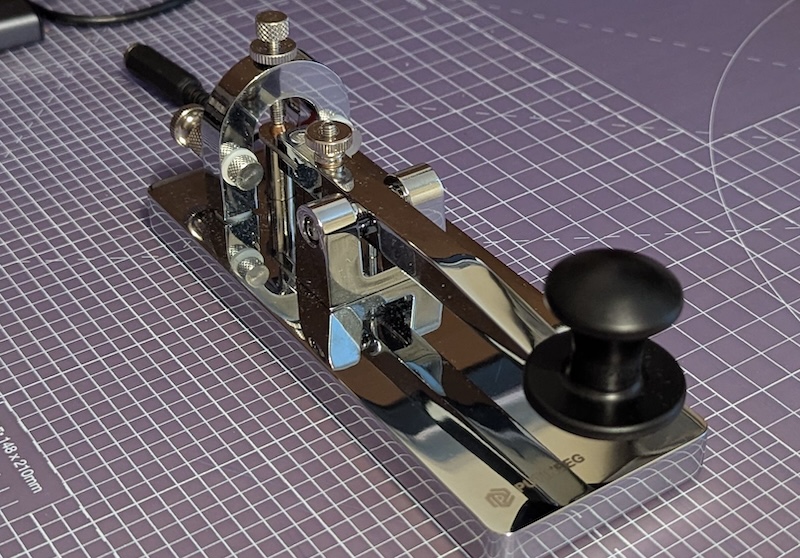
- For my 2025 Christmas present, I received the Putikeeg MCT20 Classic straight key. It's large and heavy with a nicely balanced action.
Radios
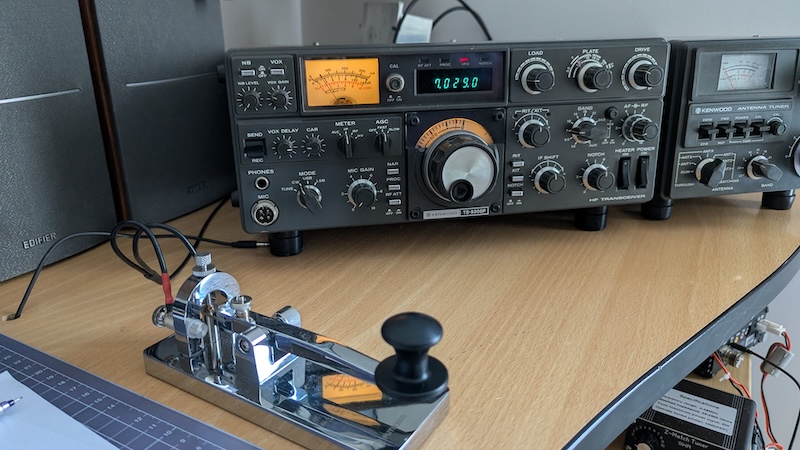
In February 2026, I acquired a lovely Kenwood TS-530SP transceiver. With three valves in the PA, it dates from the hybrid era and is well-regarded. My particular example was manufactured in February 1987, making it a very late model. This is my first 100W radio and getting it marked a transition in my pattern of operating. I use a matching Kenwood AT-230 ATU with it.
For three years until 2026, I used a Xiegu G90 as my main radio. It's a terrific package - compromised in every way of course but that's no surprise for a £400 transceiver. I picked it up in a silent key sale for half of that as my 60th birthday present and I have no complaints at all.
The G90 package offers modest performance in a very versatile package and it's allowed me to explore the hobby and I'd have no hesitation in recommending it to any novice on a budget, especially CW operators. Its 20W output is limiting on SSB but more than adequate in most conditions for CW. The built-in ATU will match a very wide range of impedances and it will work on voltages beneath 12V. It's rugged and I don't worry about breaking it when out and about. A 6Ah LiFePo battery gives me up to 6 hours of operating and I like to use detachable head unit on my lap while the main body sits elsewhere.
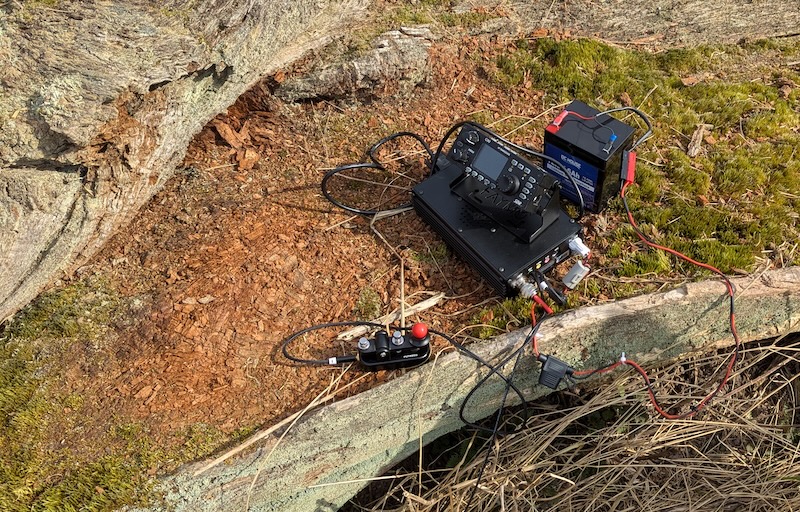
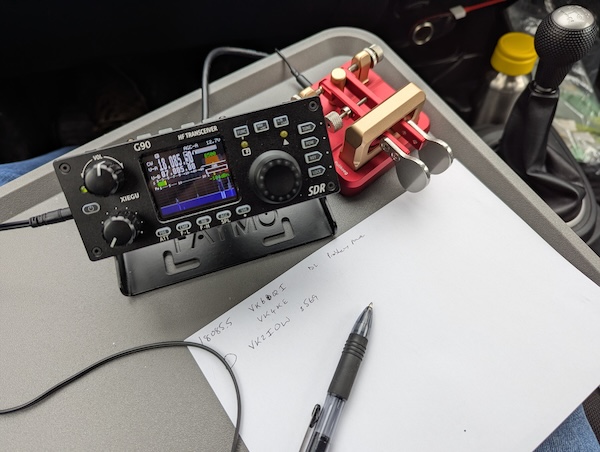
For a base station though, the G90's compromises are more challenging. The received audio is harsh and the user interface is cramped. The controls are a bit fiddly and the screen, though offering a useful waterfall, is tiny.
Would I replace it? No, I will definitely keep it. I can enhance it though, and I have a plan to make a rig control interface using bigger knobs and buttons.
My first HF radio was the QRP Labs QCX+ which I built for the 20m band. The construction was most of the fun and the assembly instructions are excellent. The power output was disappointing and that made it much too hard for a complete CW novice like me. I'm glad I got the G90.
Feed line and balun
In 2025 I bought a reel of RG174 coaxial cable and have been very happy with it. The losses are greater than the Ultraflex 7 that I was previously using but the thinner cable has the great advantage of being able to pass between the window and the window frame, even when the window is tightly shut. I previously used a 10m length of RG58 when working portable but saved significant weight by using shorter lengths of RG174.
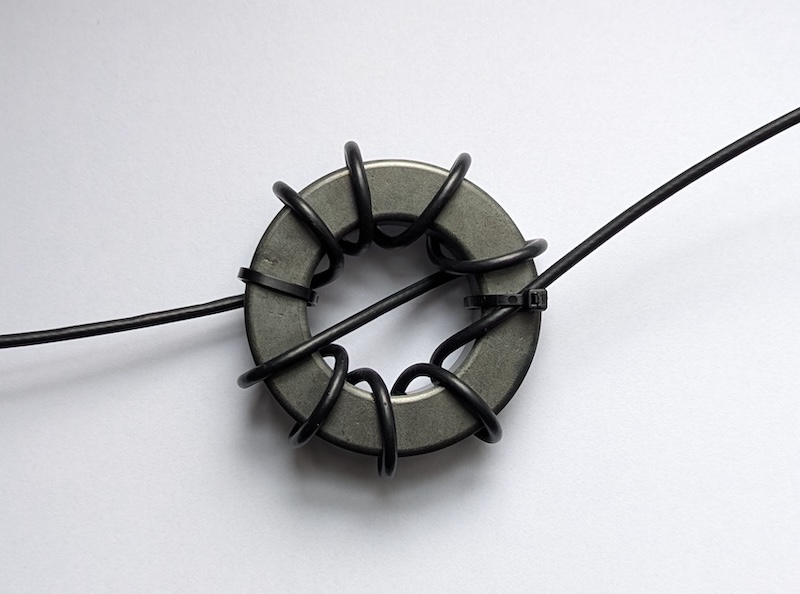
On 2025-07-31 I added a simple choke to the feedline near the radio to remove stray RF.
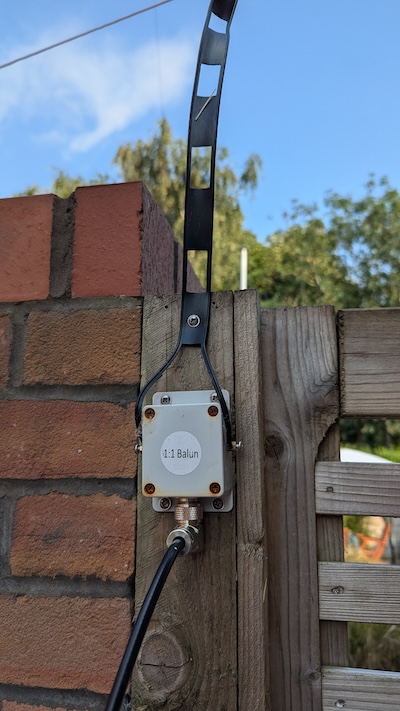
At home, the coax terminates into a 1:1 balun, rated for 400W, which then feeds the ladder line of the antenna.
Antennas
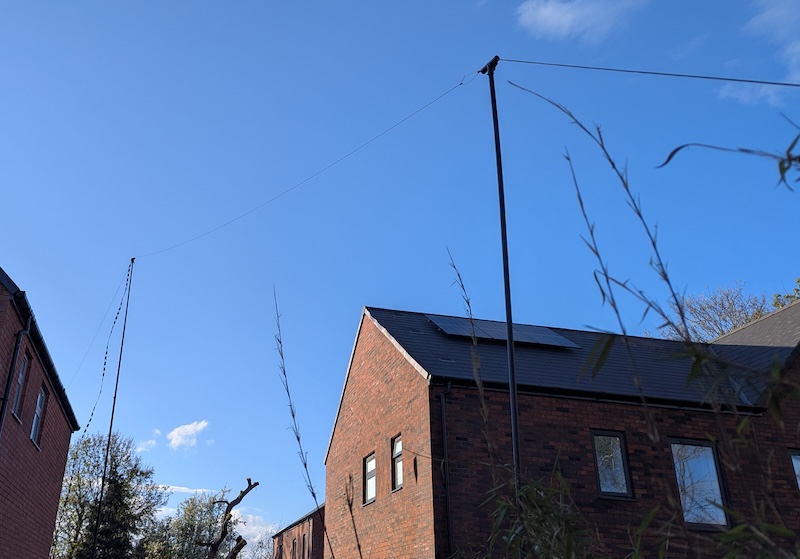
Experienced amateurs know that antennas are more crucial for overall performance than radios. The most basic radio will make contacts with a reasonably good antenna but a poor antenna will hugely restrict every other aspect of a station. However, perfection can be the enemy of the good. Very few operators have the opportunity to mount uncompromised antennas. My small garden doesn't offer much space so I opted to use a half-size G5RV doublet, fed from a telescopic pole. One leg of the antenna is supported via a length of paracord to a pole at the end of the garden; the other is lashed over the roof of my house. The feedline terminates at the 1:1 balun on a gate-post.
The G5RV is resonant only on the 20m band so I need the tuner to match other bands. The majority of my contacts are on 40m and 20m but I have made contacts on 17m, 15m, 12m and 10m.
My first HF contacts were with a dipole mounted on top of the 1.8m fence panels around my garden. I was new to the hobby and had prevaricated about what antenna I could possibly use. I spontaneously decided, while listening to a station in Bury St Edmunds through a web-SDR, to rig up a 40m dipole to see what happened. Twenty minutes later, I was able to work the same station from my own radio and my HF adventure began.
Accessories
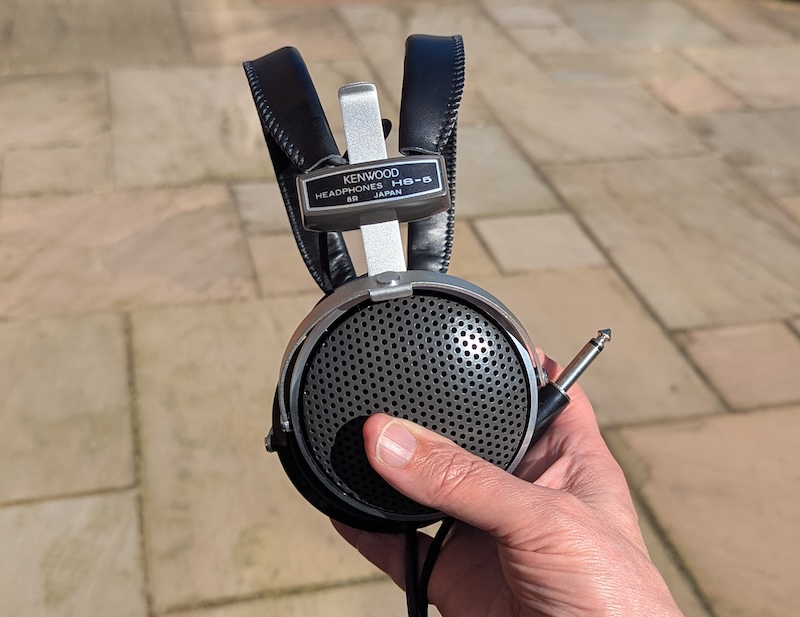
I bought a Kenwood SP-520 loudspeaker and a pair of Kenwood HS-5 headphones to use with my TS-530SP. The speaker is from an earlier range and may date back to the 1970s. The headphones were also second-hand but they appear to be unused. The model is still in production and I was glad to get them a good deal less than retail price from an eBay seller. Until March 2026, I was using a pair of hi-fi headphones but they reveal too much hiss. The Kenwood speaker and headphones are designed specifically for amateur radio so as well as being mono, not stereo, their frequency response falls off above 4kHz.
Logging and QSL cards
I prefer to head-copy what I receive on the air but with pencil and paper I write down time, frequency, callsign, name, QTH, RST received and sent, plus any other interesting facts.
After a session, I update my permanent log which is kept as a Google Sheet. This is conveniently accessible on my phone when I'm not at a computer. I have looked into commercial logging software but haven't come across any that suits me. My main logging sheet records the typical details of a QSO. On top of that I record my power output, location, callsign, POTA reference, rig and antenna. I have automated the DXCC look up so the spreadsheet generates the country and flashes NEW! in red when I work one for the first time.
The Stats sheet summarises my activity by band, mode, DXCC.
A third sheet is Callsign check. This allows me to enter a callsign and produces extracts from every QSO made with that particular contact, together with a link to their QRZ.com page. It's very useful during a QSO to be able to see if and when we have worked each other before and any notes that I made. An ADIF sheet reformats the QSO essentials and makes it very easy to upload contacts to the QRZ.com log.
I don't collect or send QSL cards, primarily because of cost. With a small budget and even with the economy of the RSGB bureau, I'd rather use my funds for bits and pieces.