
Thursday 16 April 2026
There didn't appear to be much activity on either the 40m or 20m bands today.
I caught ON4CHK/P operating from a portable location. It is always satisfying to assist an operator out in the field and despite some QSB, the signals remained sufficiently stable to complete a successful exchange.
I chatted with Ray GM3ABZ for the second time.
However, on 20m, I drew a complete blank.
Things improved a couple of hours later when Paul G0OER called on 40m with a nice clear signal. We ragchewed for over 45 minutes until suddenly the band closed within seconds. We had to finish by WhatsApp!
Thursday 9 April 2026
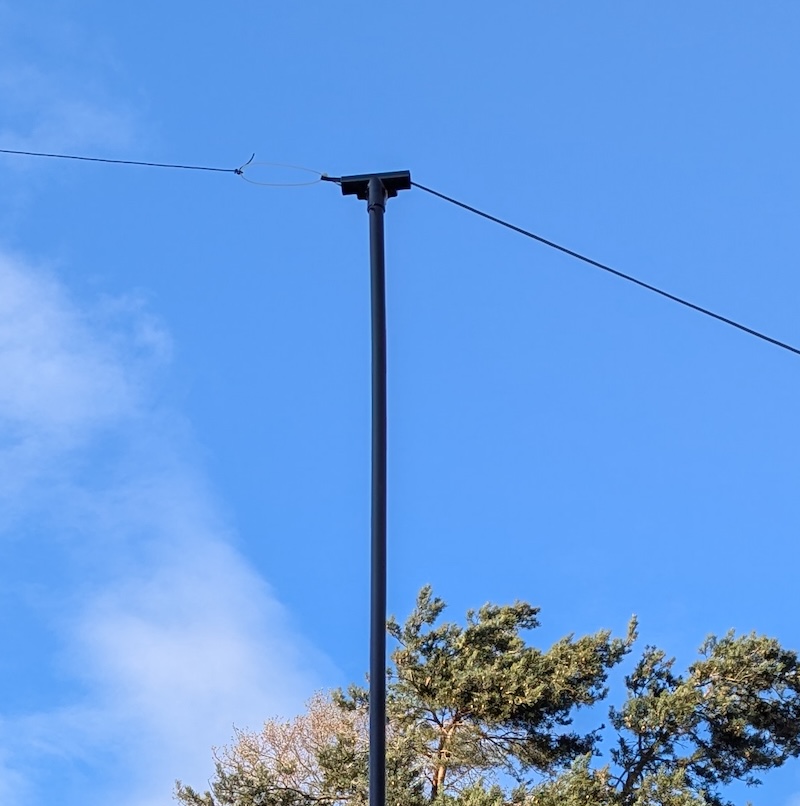
After my chat with David on Monday, I thought it was time to make a couple of small improvements to my half-size G5RV antenna. At the end of its south-eastern leg, I fitted a looped plastic cable tie to act as an insulator between the antenna wire and the paracord. Then I fed the paracord through the tee at the top of the plastic conduit tube and tied it off to the garden fence via a bungee cord to maintain tension.
I tried three bands today - 40m, 20m and 30m - and although the Reverse Beacon Network showed my signals getting out well, I only managed one QSO. It was with Bert IK2JET in northern Italy on 20m. He could only give me a 539 report and was having to contend with QSB.
Monday 6 April 2026
David G3ZPF and I had our regular weekly ragchew. Propagation hasn't been great at the time of the RAOTA weekly CW net but we have no difficulty covering a couple of miles with ground-wave propagation.
David told me that he needs to replace the 'dog-bone' insulators on his antenna and it got me thinking. My G5RV doesn't have insulators - I have simply tied off the antenna wire to a length of paracord. This isn't ideal as the paracord stays damp and may leak current, especially now that I have a more powerful radio which probably puts a few hundred volts at the ends of the dipole elements.
Sunday 5 April 2026
It's been a while since Bryan G0GSY had a chat, so it was good to catch up. He's a retired marine radio officer so his sending is impeccable and a pleasure to copy.
Saturday 4 April 2026
Steve M0STN and I had our sixth QSO. Last time we made contact, it was with less than 1W each way but today he was using 125W. We agreed that it's fun to mix things up.
Tony M0PKD told me that the sunshine had arrived in Accrington. He peaked at S9 +20dB with me and was using 200W power. Over recent weeks I have settled into using about 50W power with my TS-530SP and that feels right for my CW ragchews on 40m.
Wednesday 1 April 2026
Matt G4IYT is a relatively new CW operator like me and we had a really nice chat. He kindly followed up with an email to say how much he enjoyed it and told me that it was the first time that he had gone beyond the standard exchanges. It's great to find that new and younger amateurs are getting into CW and I'm very impressed with how quickly he has learned the skills. I think he progressed twice as fast as I did.
Lots of QSB got in the way of a chat with Ian G3YUE but I had more success with Colin G4LJU in Redhill.
I finished up a really good session with Ray GM3ABZ who was using a nice FTDX101MP.
Monday 30 March 2026
Chatting with David G3ZPF has become a regular part of my Monday mornings. We usually do at least an hour and that amount of headcopying is really good to build my concentration. I've noticed quite an improvement in just a few weeks.
Sunday 29 March 2026
The 40m band is much busier with UK CW operators on Sunday afternoons than at other times of the week and I often find new stations to work. Today I ragchewed with Geoff G3WZP in Bournemouth, Steve 2E0IIV and Brian G0SZR.
Steve has, like me, been an active CW operator since 2021 and it was great to hear a clear signal from his IC-705 which was running 10W.
Saturday 28 March 2026 - interpreting the ionogram
I started with a quick exchange with POTA station G/KE4WLE who was trying for a first-time activation of GB-6000 Cliff Park in Harwich. It's the first time that I have worked an American operating in the UK.
Band conditions have improved over the last couple of days. The Reverse Beacon Network showed my 40m CQ calls being picked up in both the UK and on the continent.
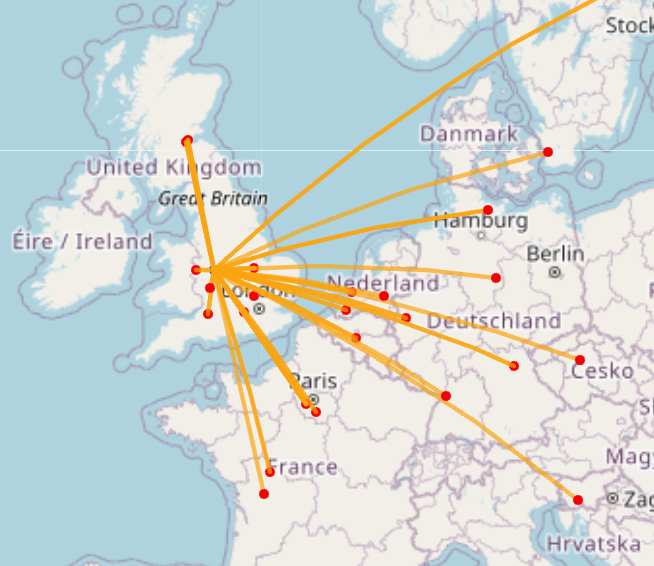
I had a nice long slow QSO with Tom EI9FP in Dublin. He sent slowly so I copied his speed. We had a good chat at an effective speed of about 12wpm. He modelled QRS CW - very accurate sending with faster characters and good gaps. As the QSO progressed, our signals faded but overall his Icom IC-756 and random wire performed very well.
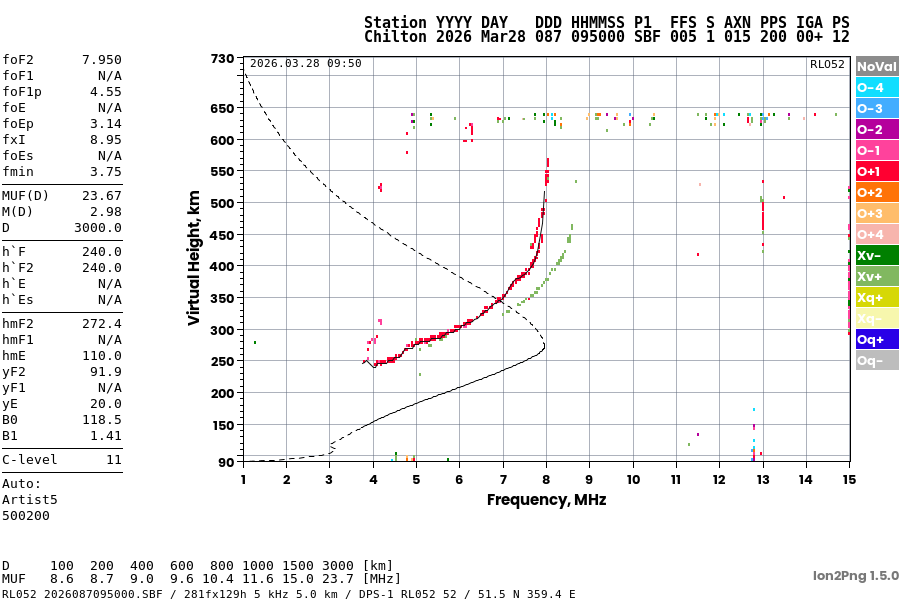
I have been learning how to interpret the data produced by the UK Solar System Data Centre. The ionogram for the Chilton research station is shown above.
The first thing I look for is the foF2 value. This is the critical frequency, which is the maximum frequency at which radio energy is refracted vertically from the F2-layer of the ionosphere using ordinary mode propagation. When the foF2 value exceeds 7.03kHz, I know that it should be possible to work nearby stations on the 40m band using CW.
The ionosonde data is refreshed every ten minutes and it is interesting to follow it in the morning as the sun's radiation creates more excitation in the ionosphere. At this moment in the solar cycle, I find that a useable foF2 on the 40m band occurs between 0800z and 1000z. However, solar weather has a large effect; last week the foF2 was well below 7MHz on several days. The practical effect for me was that it was hard to make contacts. Some shallow refraction from the F2-layer occurred at 7MHz for distant contacts but the lower D-layer absorbed all but the strongest signals.
This was confirmed by the relatively high value of fmin. This is the lowest frequency at which any echo from the ionosonde is received. When the fmin approaches foF2, it means that D-layer absorption is high.
Looking at today's ionogram, the relatively high foF2 value of 7.95MHz and the relatively low value of fmin of 3.75MHz, show that near vertical incidence skywave (NVIS) propagation for my 7MHz signals is good and that D-layer absorption is low. Good times!
The graph shows a red trace plotting the received ionosonde signal at a range of frequencies. The x-axis shows the frequency of the ionosonde and the y-axis is a measure of the time taken for the radio energy 'echo' to be heard. On this morning's plot, the red trace is both long and clean (not diffuse, which implies fairly settled geomagnetic conditions) A long, clean red trace of this ordinary mode refraction suggests good conditions for local contacts. The trace moves steadily upwards until the critical frequency is approached, when it becomes vertical. Because the radio waves slow down in the ionised F2-layer as the frequency increases, they appear to be being refracted from a greater height. As the ionosonde's transmission approaches the foF2 frequency, this virtual height rapidly increases. At frequencies higher than the asymptote (where the trace is vertical), no echoes are received showing that the radio energy has passed through the F2-layer to be lost into space.
The other key data value that I look for is the MUF(D), which is the maximum usuable frequency for a refracted radio signal at a specified distance. The distance is usually 3000km, and is shown as the D value. Today's MUF(D) is 23.67MHz at the 3000km distance. That means that a signal on the 15m band should be able to use the ionosphere above Chilton to skip 3000km. Higher frequencies will not skip due to excessive D-layer absorption. Of course, ionospheric conditions vary between locations, so this local data does not give the full picture for a DX communication.
The ionogram shows other other interesting data too and I have come to realise just how complicated the science of propagation is. Nevertheless, if I am looking for a local chat, before I even switch on my radio I load the latest ionogram to check if propagation is going to be favourable.
Friday 27 March 2026
Just one 40m ragchew today, with first-for-me Frank PA3FRC near Rotterdam.
Monday 23 March 2026
David G3ZPF and I chatted for an hour, mostly about gardens.
Band conditions have been poor for the last few days following a solar flare last week.
Thursday 19 March 2026
HamAlert told me that Paul was activating POTA GB-1055 at Gower Coast National Nature Reserve with the callsign GW0OER/P. I joined the queue and hopefully enabled him to claim the activation.
I heard G4WDZ also calling CQ POTA and we had a brief exchange.
For a longer ragchew, I called CQ on 7028kHz and was pleased to spend some time in the company of Ian M7OPR. We chatted about our positive experiences of the Xiegu G90 and my new Kenwood TS-530SP. He told me that he's recently been experimenting with RTTY.
Wednesday 18 March 2026 - how do you send a space?
When volunteering at the National Radio Centre, I love introducing Morse code to people who are unfamiliar with it. Almost every visitor has heard of Morse code, but as they experience it many questions arise. When looking at a sheet of characters and their Morse code equivalents, the most common question is, "How do you send a space?"
People are so familiar with keyboards that they're looking for the equivalent of the space bar. When most used pen and paper, it wouldn't have occurred to them to ask how words should be separated. A writer doesn't write a space, they leave a gap.
For CW operators, it is actually helpful to think about sending a space, that is to leave a gap with some mental deliberation. The human mind races far quicker than the hand and unless a novice operator is deliberate, the gaps disappear. I've heard CW on air that's just a continuous stream of dits and dahs. To the person holding the paddle or key it probably makes perfect sense but to me, even at an easy 15wpm, it's garbled.
The strict convention is that the gap between words should be seven dit-lengths. That feels about right, especially when sending the most familiar phrases, e.g. "TNX FER CALL."
In a ragchew, it can be helpful to give the receiver's brain a moment longer to catch a surprising word. And when I'm thinking about what to say next, the pauses can become so extended that I add a '=' to confirm that I'm still present. The extra inter-word spacing is extremely helpful for beginners and in my first year on the air I would deliberately use large gaps to encourage the other station to do the same for me. This technique has an unofficial name: Wordsworth spacing.
Interpretation and meaning emerge from Morse code as we hear not just the dits and dahs, but the crucial gaps between them. Wolfgang Amadeus Mozart is credited with the observation that "The music is not in the notes, but in the silence between."
Monday 16 March 2026
I enjoyed possibly my longest ever CW QSO. David G3ZPF and I chatted away for 75 minutes. He sends good code, just slow enough for me to copy about 90%. That really stretches my brain but I think that's around the sweet-spot for learning. The band conditions weren't great with a critical frequency below our 7011kHz. Continental stations were coming in strongly. David is only 3 miles away so we were using ground wave and I had no difficulty.
Friday 13 March 2026
Just a couple in the log today: 40m contacts with Wim PD0HRS and Paul G0OER.
I tuned up on the 10m band for the first time with my new radio and heard a couple of Canadian stations but I was unable to make the contacts.
I also tried the 30m band but that was very quiet.
Thursday 12 March 2026
I stayed with manually changing over between send and receive (see yesterday's post below) for three satisfying 40m band QSOs this morning.
Peter G3OJV was on the QRP centre of activity with his tiny QMX. Although the signal was close to my noise floor, I was able to copy him perfectly.
Rich G4PCE used his Elecraft K2 to send from Solihull and I finished with Ekrem DJ0AJ in western Germany.
Wednesday 11 March 2026 - The TS-530's send and receive switch
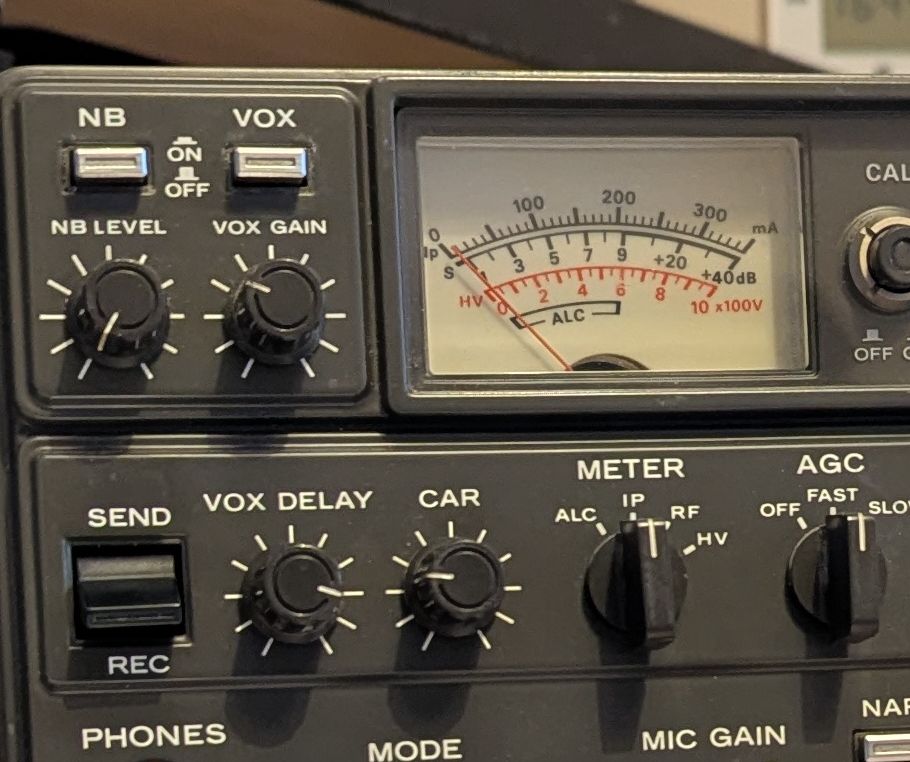
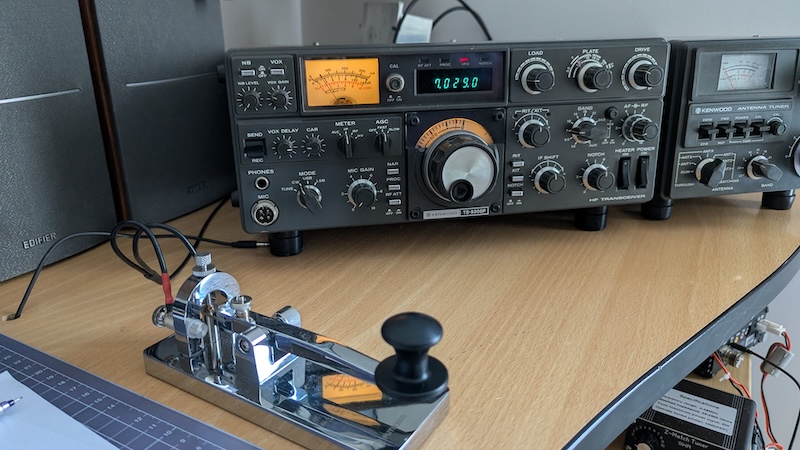
I made another journey back through amateur radio history with the help of my magical TS-530SP by experimenting with its manual SEND/REC (send/receive) switch.
Up to now, I have taken it for granted that as soon as I send the first dit or dah with my Morse key, the radio will automatically change from receiving to transmitting. That's the way my Xiegu G90 and my QCX+ work. During the transmission, radios must become 'deaf' because it have to disconnect their sensitive receive circuits, which would otherwise be damaged by exposure to the RF energy of the transmitter. When I stop sending, those radios reverted to receiving again after a small delay. This 'hang time' can be adjusted to suit personal preference. I have tended to keep quite a long hang time of a few tenths of a second. Other operators, especially contesters, like to open up their receiver very quickly. Some radios use fast electronics to even allow the switchover to happen so rapidly that the radio will receive between the dit- and dah-elements of each character.
For the first couple of weeks of using the TS-530, I carried over my previous way of operating, using the break-in feature to automatically take care of the changeover. The TS-530 does this using the VOX control, which offers sideband users a similar way to trigger a transmission, simply by speaking into the microphone. I was rather surprised by the heavy clunk that came with each changeover, as a substantial electro-mechanical relay swung its contacts.
I much prefer a proper chat when I'm operating so it's not uncommon for each over to be a minute or more. When I'm thinking of what to send next, I may pause for a second, which is long enough tripped the switchover back to receive. (If I extended the hang time too long, I risked missing the start of my partner's reply.)
Reflecting on this led me to consider manually switching between send and receive using the SEND/REC switch. I used it for today's QSOs and found it quite straightforward and surprisingly satisfying. It meant that the radio stayed quiet throughout my 'over' and avoided stressing the changeover relay whose thunk would also disturb my train of thought. It also gave me a greater sense of having the radio under my total control.
In the early days of radio, operators would throw a large knife-switch to disconnect the antenna from the receiver and connect it to the receiver. Break-in first appeared for CW operators as a development of the VOX feature that SSB operators had used since before the war. The full break-in features prized by contesters began appearing using PIN diode switching rather than relays during the 1970s.
I'm going to stick with manual changeover for now. I guess that it won't be long before muscle memory will make it a natural reflex.
At the start of this new operating habit, I had terrific QSOs with Patrick VK2IOW and for the first time with Nic VK7WW in Tasmania. It doesn't count as a separate DXCC entity but it's still a thrill to get a VK7 in the log. Nic and I exchanged emails afterwards and we're looking forward to future contacts.
Monday 9 March 2026 - The TS-530's digital display
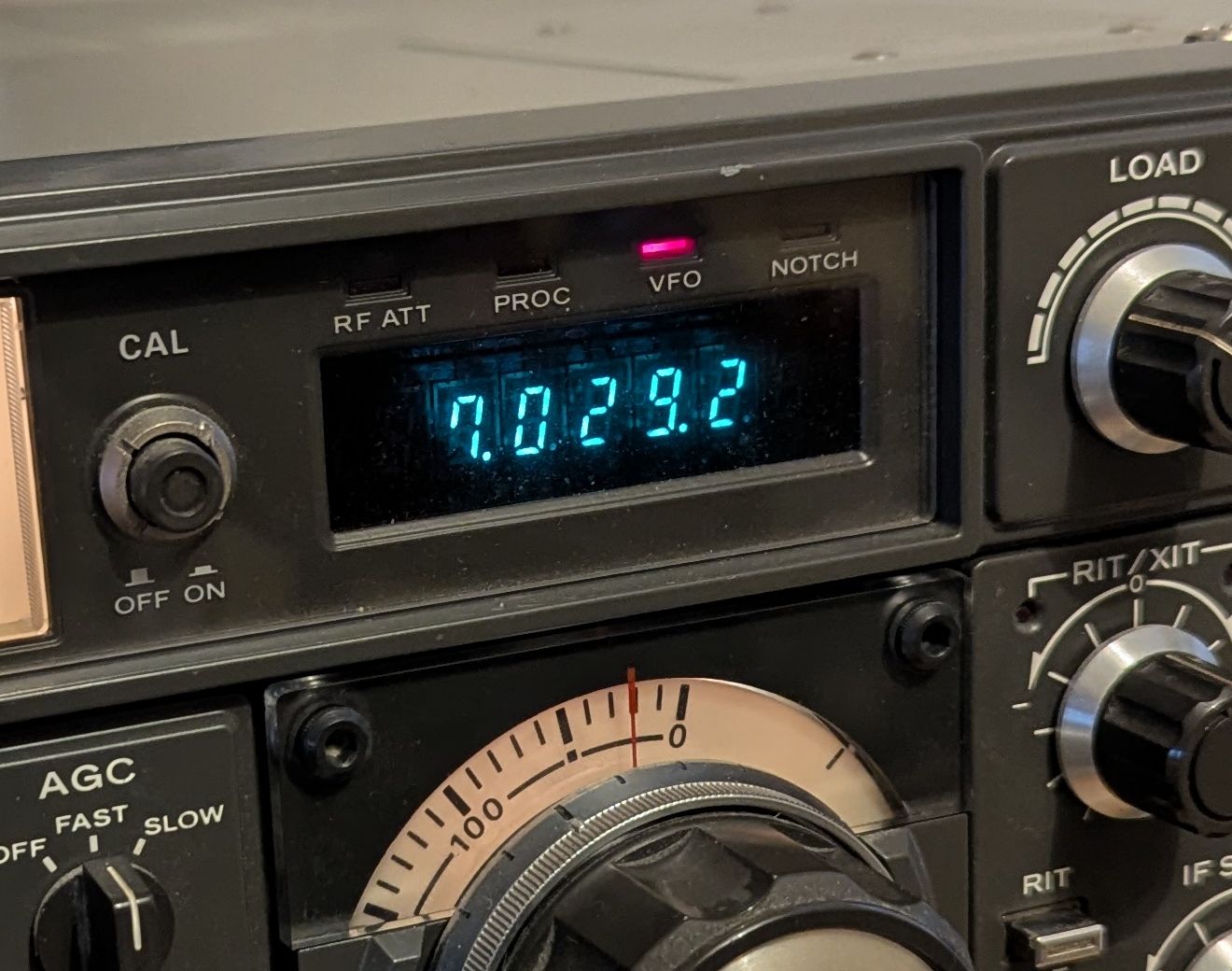
In CW operation on modern radios, we simply tune to a station, then send and receive, relying on the displayed frequency with the same confidence that we have in the display on our microwave oven. If say, we know in advance that our friend will be calling us on 7030kHz, it's a matter of simply tuning our radio so that its display shows 7030 and waiting for him to appear. Radios today have such a high degree of accuracy and stability that we don't doubt that their displays tell us exactly the truth, the whole truth and nothing but the truth. Through using an older radio, I've come to realise that things are actually a bit more interesting.
I came to the amateur radio hobby just a couple of years ago and up to recently I have only used SDR radios. Using powerful computer processing they perform a digital down-conversion so that all the energy in the received RF spectrum becomes numbers. To 'tune' a frequency, no physical change is made in the circuits inside; the computer merely manipulates its digitised representation of the received signal at the specified frequency to generate the audio tones that we hear.
The technology inside my older TS-530SP achieves the same result in a completely different and wholly analogue way. Instead of monitoring a larger band of signals and working upon them mathematically, it tunes a particular frequency by mixing it with the local oscillator. What we hear is the product of this mixing.
Now back to our friend's 'sked'. If we were truly listening to 7030kHz, we would never hear our his transmission at all. We would be 'zero-beating' his carrier wave with the result that nothing audible would appear in our loudspeaker. To actually hear a tone, our receiving frequency needs to be offset. If we want to hear our friend's signal at an audio tone of 800Hz, we will need to tune our receive to 7029.2kHz.
Before digital displays appeared on radios, when the tuning scale was only an approximation, knowing an exact frequency didn't matter too much. If our friend told us to expect to hear him on 7030kHz, we couldn't expect modern precision. His transmitter might be there or thereabouts and it quite likely would drift over the course of a QSO. Amateurs knew to tune around to find the expected transmission with fairly broad filters and to adjust their VFO in order to find the station they were looking for.
When Kenwood introduced digital displays in the early 1980s, these gave the operator even more help by revealing what frequencies were being used inside. The numbers on the TS-530's digital display are derived from a frequency counter that shows the two crucial frequencies in CW mode: When the key is up it shows the receive frequency and when the key is down, it shows the transmit frequency. Note that the numerical display is a reporting device. There is no digital frequency control; the operation of the VFO is entirely analogue.
When I first started using the TS-530, I thought there was something wrong: Why wasn't my friend's signal appearing at the frequency that I was expecting? I now know to find his 7030kHz transmission, I must do some arithmetic and set the analogue VFO so that the display counts a frequency that is 800Hz lower at 7029.2kHz. This made perfect sense forty years ago but it can be confusing today. It wasn't a problem to anyone who had experience of earlier generations of radio. They knew that two frequencies were involved and I imagine that they were quite impressed that they could now see, in digital form on the Kenwood, the frequencies at which both analogue circuits were oscillating.
During the 1980s, Kenwood and other manufacturers decided that revealing both of these frequencies was unnecessary. They elaborated their designs to hide the receive/transmit offset and to present a single, unchanging number. This meant that no mental subtraction was needed to choose a receiving frequency in relation to a transmitting frequency. The operator had only one frequency to think about. I suppose it was one step among several in which amateurs became users of their radio's interface rather than technicians dealing directly with the physics of its operation.
One of the reasons that I am enjoying a radio of this particular vintage is that it's showing me more of what is actually happening during my communication. What at first looked like a discrepancy is now an insight into the way that the CW signal is detected and the methods that turn the received RF energy into intelligible sound and a meaningful message.
Today I had very brief chats with Tony M0PKD and David G3ZPF before having to go out.
Friday 6 March 2026
Will GM0HKS had another fine ragchew, chatting away for about 40 minutes.
I was then delighted to have a first QSO with Julian G4ETS who was using his home-brewed replica paraset running a mighty 3W. It sounded really good and until other stations started on his frequency, it was easy to copy him.
Wil F/ON4AVT was pretty weak somewhere in France but we managed our QSO.
Thursday 5 March 2026
Another nice time on 40m where a ragchew at a pleasant speed isn't hard to find.
I worked Rob G3XFD for the first time.
When I told Jon GW0FJT that I was using a TS-530 that I had just bought, he asked if I had got it from Rupert G4XRV which, of course, I had. We shared pleasant memories of Rupert's fine shack.
I finished with NRC colleague Chris G7BED who was using a vintage Yaesu (I think the FT920) from his garden shack.
Tuesday 3 March 2026
The period around the equinox seems to coincide with the best long-path propagation to Australia, which helped me work three VK stations from my house for the first time.
Patrick VK2IOW was first and strongest and reported that my signal was clearer than last week. I worked special Polish station SN31ROT and then my NRC colleague David G3DJB down on 40m before popping back up to 20m.
I finished with a first-time contact with Ian VK5CZ in Clare, just north of Adelaide and finished with David VK3DBD for both of which I used the the web-SDR in Ironstone Range to receive.
Moving twice between bands led me to go through the retuning process. I'm still very careful to get it absolutely right so I take about five minutes to do it. I've read online that people claim it only takes a few seconds but I can't believe that they're not skipping steps in the manual to do it that quickly.
Monday 2 March 2026
I had a good ninety minutes on the air this morning, by the end of which my brain had just about enough of copying CW!
I caught up with Peter G0GYY in Walton, with Mary G0BQV and David G3ZPF.
Thursday 26 February 2026
After an hour of fun and games pondering the alignment of the radio, I worked Dave G0DJA, CW OPS president Stew GWETF and Alan G0TAM, all on 40m. Dave was using just 5W and I took the opportunity to drop the power from 50W to about 5W. Dave reported only a marginal drop in signal strength. It's actually quite difficult to run the radio at very low power. The difference between 5W and zero output is a tiny fraction of a turn of the CAR control.
Tuesday 24 February 2026 - TS-530 phones home
My first time operating the new radio on 20m. I joined the Australian and New Zealand CQ-QRS net at 0800 and started calling, monitoring the Ironstone Range web-SDR to see how my signals were reaching the other side of the world.
I got a reply, but not from Australia. Manabu JI2MED is my first Japanese contact. He's in the town of Shima, in Mie prefecture, which is only about 100 miles from the factory in which my Kenwood was made. Manabu has proved what can be done with investment into antennas. He pushes 500W into a self-built loop-fed array Yagi. This would explain why he did better to receive me than I did to hear him. We managed the QSO with me listening through the Australian web-SDR. We exchanged emails and Manabu confirmed that he was beaming on the long path. That means that my signals reached him after a 19,000-mile (30,000km) journey from my half-size G5RV antenna. That's a new distance record for me - about three-quarters of the Earth's circumference.
Old friend Patrick VK2IOW joined in the fun and was very clear copy: a good 559 signal with no fading.
I finished up with Gerhard DJ2GS in Feldberger, Germany.
I ran the full 100W this morning. That's not something that I'm going to do regularly but it's good to see how well the radio behaved.
Monday 23 February 2026
While warming up for the RAOTA net, I caught Peter G0GYY and Will GM0HKS.
David G3ZPF opened the net on the dot of 1000, up at 7012kHz, just along from last week's frequency. We chatted away very easily for over half-an-hour.
Sunday 22 February 2026
I've made lots of notes on the tuning procedure for the new TS-530SP. Not only do I want to preserve the health of its delicate components but I want to understand what's going on in the balancing and matching process. So after plenty of research, I've thoroughly documented the steps, explaining to myself what their effects are and why they're necessary.
When all set to go, I worked Fred G4HOM. By another astonishing coincidence, Fred was using the Elecraft K3 that he bought recently from Rupert G4XRV. So two radios that belonged to Rupert a few weeks ago were now in contact with each other.
I'm thoroughly delighted with the new station. I suppose it could be seen as a step back to a less convenient technology. But that criticism could be levelled at amateur radio in general and especially at CW operating. I'm not after convenience, I want to experience the art and science of it all. The hybrid TS-530SP, with three valves in its final PA and a delicate analogue sound, certainly provides me that.
Saturday 21 February 2026 - on the air with valves
I made up a 50-ohm dummy load using a huge heatsink that I picked up second-hand on eBay and a brand new Caddock 100W resistor. The next task was to fashion a screened cable with a guitar-style jack plug for my key.
With all that accomplished, who'd have thought that the first QSO that I made with the new station would be Will GM0HKS, who put me onto the possibility a week ago? It all felt very serendipitous, as if it were meant to be.
Will later sent me a video of the waveform of my signal, captured on his amazing Kenwood TS-890. The keying envelope looked perfect. It's pleasing that a 39-year-old radio can still send very clean transmissions and that it's capable of its specified 100W output, though I was only using about 25W.
Next in the log were firsts for me: David G0EVV in Morpeth and Mal G3PDH in Norwich.
Wednesday 18 February 2026 - Faroe Islands
I don't go hunting exotic DX stations but I am very happy to have bumped into Caen OY1CT calling from his small village in the Faroe Islands on 20m. It takes my country/dxcc tally to 56.
Monday 16 February 2026 - RAOTA CW Net
I've just participated in my first CW net. The Radio Amateurs Old Timers' Association (RAOTA) has a net on 7011kHz at 1000 every Monday. The association's president, David G3ZPF, put out a CQ using the association's G2OT callsign. After Will GM3VMB replied, I added my own. The three of us chatted away for the best part of an hour, passing the contact around the small group. It worked very well indeed and I shall join in again.
Later in the day, my phone alerted me to the fact that a Kenwood AT-230 ATU, a contemporary of my TS-530SP, had been listed about an hour's drive from home. I collected it from Jim M6JDB who was selling off parts that belonged to his late father, Dave M6DWB.
Saturday 14 February 2026 - a new radio!
I've been pondering what to buy as a proper shack radio. I have used the Xiegu G90 for virtually all my operating and nothing has changed my firm opinion that it's a brilliant piece of kit. Its versatility is amazing and as my log shows, it's not often that I've used its full 20W output. It made the perfect introductory HF radio for me. However, after three years and a total of 864 QSOs, I feel that a bigger radio would be better on my desk. I certainly won't be getting rid of the G90 and when the warmer weather comes, I'll definitely be taking it outdoors.
I was in no particular hurry for a new rig and with a budget that wouldn't stretch anywhere near a brand new radio, I wondered what I could get second-hand. Here's the list of my priorities:
- While the G90's small form-factor is brilliant for mobility, I wanted something with a bit more heft and presence. In particular, the G90's controls are a bit fiddly. While they're easy to manipulate if you're used to them, it does feel strange to poke about with multifunction membrane pushbuttons and peer at a tiny screen.
- The G90's audio is a bit rough. It does the job but long-term listening is quite fatiguing. I was looking for something more relaxing to have on in the background, not just in the heat of a QSO.
- It's hard to put the final element in my wish list into words. It's something to do with the fact that CW amateur radio is more than mere communication. It's evocative of past eras and there's something magical about pulling the signals out of the noise that somehow doesn't feel fitting. Perhaps the best way of explaining it is to point out the incongruity of a long-lever straight key wired to a tiny computer. I'm not just looking for something effective; I'd like something lovely.
After the very pleasant QSO with Will GM0HKS on Tuesday, he sent me an idea. A friend of his, Rupert G4XRV, had a Kenwood TS-530SP to sell at a very reasonable price. Over the days that followed, Will passed on photos of a very clean-looking radio, complete with CW filter. Looking at the internals, with gears and chains connected to the final capacitor drives, led me to admire the craftsmanship and skill that went into designs like this. When new, these cost at least a month's wages.
And so today I drove into Buckinghamshire and collected it. Rupert, generous with his time and knowledge, demonstrated it on air and showed me how to tune it, though this is something that I'll want to carefully practise with the operating manual to hand. Before I get to do that, I'll need to buy an antenna tuning unit (ATU), a dummy load capable of handling 100W and to make up a cable for the key's quarter-inch jack socket.
Before Rupert acquired the radio about a year ago, it belonged to John Tournier G3INZ, now a silent key.
Thursday 12 February 2026
The 40m band has behaving very kindly lately, so I had no difficulty working Jacek DLNCH in western Germany with my 20W.
I shuffled down the band to work Fred G4HOM just down the road in Birmingham with full 599/599 signals.
Wednesday 11 February 2026
Dave G0DJA and I had our second QSO using 5W both ways.
Tuesday 10 February 2026
With a mug of tea in one hand and my straight key in the other, it was another good start to the day.
Simon G0FOZ told me that his cat, Bug, is unhappy with the Dorset weather.
Will GM0HKS and I had a lovely long chat. He's a first-class operator in the literal FOC sense and in every other way, giving encouragement and matching my speed perfectly. He was using the fabulous Kenwood TS890. I greatly appreciate the advice he has been able to give in a subsequent email as I contemplate the purchase of another radio.
Monday 9 February 2026
When I turned on the rig and listened on the 40m band just after sunrise, I picked up several continental stations. I just about worked Stef F5TIL near Geneva.
Harry DL6LV/P could only give me a RST329 for my 10W. I actually prefer this to a solid 599 from a 100W signal. It feels that we're both working hard for the contact.
UK stations started appearing as the sun rose higher. Chris G0SDD was an easy copy in Gloucestershire. He was also using a Xiegu G90 like mine and it sounded really good on air.
I waited on 7011kHz for David G3ZPF, president of the Radio Old Timers' Association, who runs a weekly 40m CW net. I had heard him on air last week and was really pleased to find that he also lives in Wolverhampton. Over the next hour, David and I chatted away. It really tested my CW stamina but it was great fun. I shall be waiting for him next week. Meanwhile, I shall register for associate membership of RAOTA and enjoy their newsletters and activities. Who knows, they may even persuade me to plug in a microphone.
Thursday 5 February 2026
The weather has been so awful that I've stayed indoors all day. I'm very grateful for a warm radio shack (an upstairs room in my house).
I replied to my friend David G3DJB, who was working as GB3RS from the National Radio Centre at Bletchley Park.
Over the following hour I worked Peter G3OJV, Marcel F5RLH, Warren M7RVD and Gerald G3MCK.
My winter habit has been to stick to the 40m band and it's made me wonder about putting up a simple dipole instead of the half-size G5RV . I may give it a try when the weather improves.
Tuesday 3 February 2026
On a quiet 40m band, John M0ASN stood out with his strong signal from his FTDX10 and we chatted for fifteen minutes.
I then picked up Wil DL1BGR near Leer in north-west Germany.
It's a long time since I tried to work the long path on Tuesday mornings but I thought I'd see how Ross DL/M0NNK was getting on. He was using Mike's station in Stuttgart through a remote link and we QSO'd for the first time. After we finished, I heard Allan VK2GR use his impressive 4 element Yagi to give me the clearest received signal from Australia that I've ever heard at home.
Monday 2 February 2026
I sat back and enjoyed listening to Kevin MW0KXN and Simon G0FOZ for many minutes before working Kevin with his QMX. Conditions were against us though and heavy fading meant we couldn't persist for long.
Sunday 1 February 2026
The days have been slipping by. We were away in Dorset last week and I didn't bother taking a radio. Good job, as the weather was awful. The River Yarty flooded within 30m of our accommodation and we were confined to the holiday cottage most of the time.
All this gave me something to talk about on air this morning and I had a couple of pleasant ragchews on 40m. Half-an-hour with Mary G0BQV in Surbiton and then fifteen minutes with Jon GW0FJT in Llandeilo.
Sunday 25 January 2026
Just one today, I enjoyed Glen's IC-7610 on 40m, which was sending lovely code. I used 10W.
Friday 16 January 2026
Still on 40m and with 5W (my preferred combination at the moment) I briefly worked Andrew G4HVC near Lincoln.
Later in the day, I spent a very pleasant 33 minutes in a ragchew with Terry G4AYR near Oxford. He was using his Elecraft KX3 with 5W. Another radio that I covet!
Thursday 15 January 2026
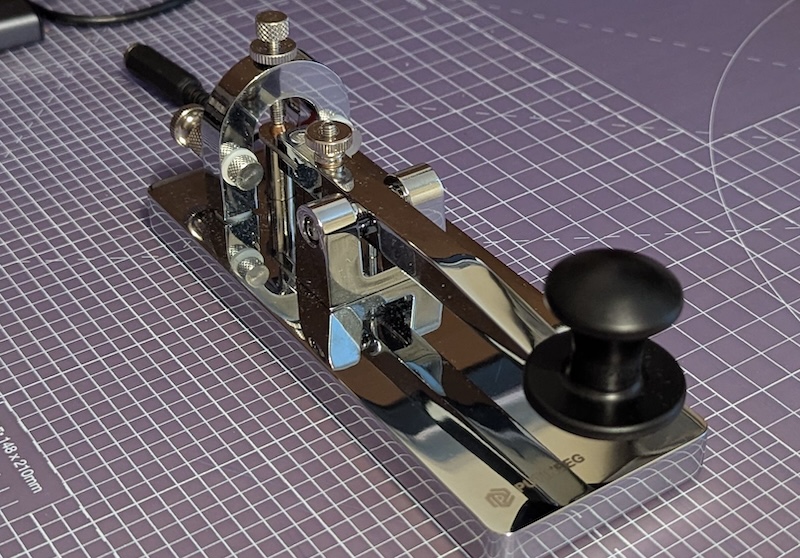
I've been tinkering with the adjustments on my new straight key and thought I had found the perfect combination of a tight contact gap and a light spring. However, on a handful of occasions, the key has stuck, leading me to transmit one very long dah. It happened again yesterday, just as Tony G3ZRJ answered my CQ call.
Embarrassed, I sent "SRI" a couple of times. Tony was very kind about it all and I must have given him a chuckle. His QRZ.com page is well worth a read. He spent a career in communications, including working as a merchant navy radio officer and at Portishead Radio maritime station, plus a long spell in research in the civil service. I always enjoy these contacts with former professionals.
I also made contact with Alan MW0BGL in Llanelli. We were doing really well until the signals faded very quickly as the sun went down.
Monday 12 January 2026
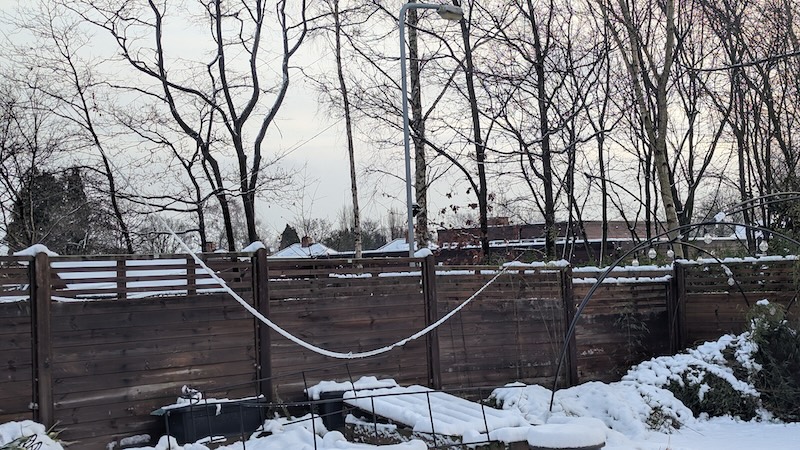
We've had the coldest weather of the winter recently. On 9 January, ice built up on half-size G5RV antenna to such an extent that it almost touched the ground. It's supported by a plastic pipe, reinforced with a wooden dowel, but that couldn't bear the weight.
Thankfully, the thaw arrived over the last 24 hours and the antenna sprung back up almost to its previous position. I'm contemplating a better arrangement for the supporting pole.
Thursday 8 January 2026
I enjoyed a fifth contact with Will GM0HKS in Motherwell. We chatted for over half-an-hour and discussed the forecast of heavy snow here in the West Midlands.
Peter GM3VMB jumped on immediately afterwards for our second chat in a few days. We've exchanged very pleasant emails since our first chat.
Tuesday 6 January 2026
There was fading on the 40m band this afternoon but that led to some exceptionally strong signals between Peter GM3VMB in Lockerbie and me. At times his signal peaked at 30dB over the S9 level and I had to turn down the volume to save my ears (I prefer not to use the AGC on the Xiegu G90 because it raises the noise to a tiring level).
Peter and I chatted away for over half-an-hour. He makes splendid Morse keys and I enjoyed listening to his cootie. More information on his sideswiper.net page.
Peter kindly passed on his wishes to my xyl following a nasty fall on the ice yesterday which has left her with a broken arm.
Monday 5 January 2026
First contact of the day was with Graham G4EUK in Shoreham on the south coast. He used 5W and I used 2W. A very pleasant chat but Graham was battling a high noise floor so we didn't stay on for long.
On the 40m band I tend to hang around the 7028 to 7031 area these days, which is popular for decent chats rather than brief exchanges. It pays to look around though, so I often keep an eye on the waterfall of a web-SDR to see what else is going on. I noticed strong signals up at 7039kHz, just under the data modes section of the band.
It was a real pleasure to hear Claire M8JKQ and Peter G0GPH chatting away in steady Morse at about 15wpm. I looked up both of them on QRZ.com and saw that Claire has been licenced as long as I have. Peter, on the other hand, started his interest in the 1960s and was licenced in the 1980s.
When they finished, I sent my callsign and Peter replied. We conversed for half-an-hour and it was great fun. His sending is perfect, so it was very relaxing to enjoy 100% copy. Peter told me that he uses a Chevron paddle. I haven't heard of the brand before but they do seem to have an excellent reputation.
Sunday 4 January 2026
Neil M0NJH suffered from high noise when we made contact on 40m so we kept it short. I used 5W on the 7030 QRP centre of activity.
Friday 2 January 2026
A nice quiet start to the new year saw just a couple in the log today, both on 40m with 10W power. Tony M0PKD and Gordon MM0GOR. The chat with Tony gave me the chance to give a negative temperature (-1C) and to comment on the snow on the ground here.
Thursday 1 January 2026
I enjoyed a nice early start on the 40m band with Luko F4GMM near Paris. I then called CQ and although it was disappointing that no one replied, it was gratifying that my 5W signal was picked up by three US stations on the Reverse Beacon Network.
At lunchtime I heard the special events station GB100GBR calling CQ to celebrate the 100th anniversary of the first transmissions from the Rugby Radio Station. In fact, my brief contact was made 100 years and 30 minutes after the original GBR Morse telegraph transmission to the Imperial Wireless Chain at 16kHz on the VLF band.